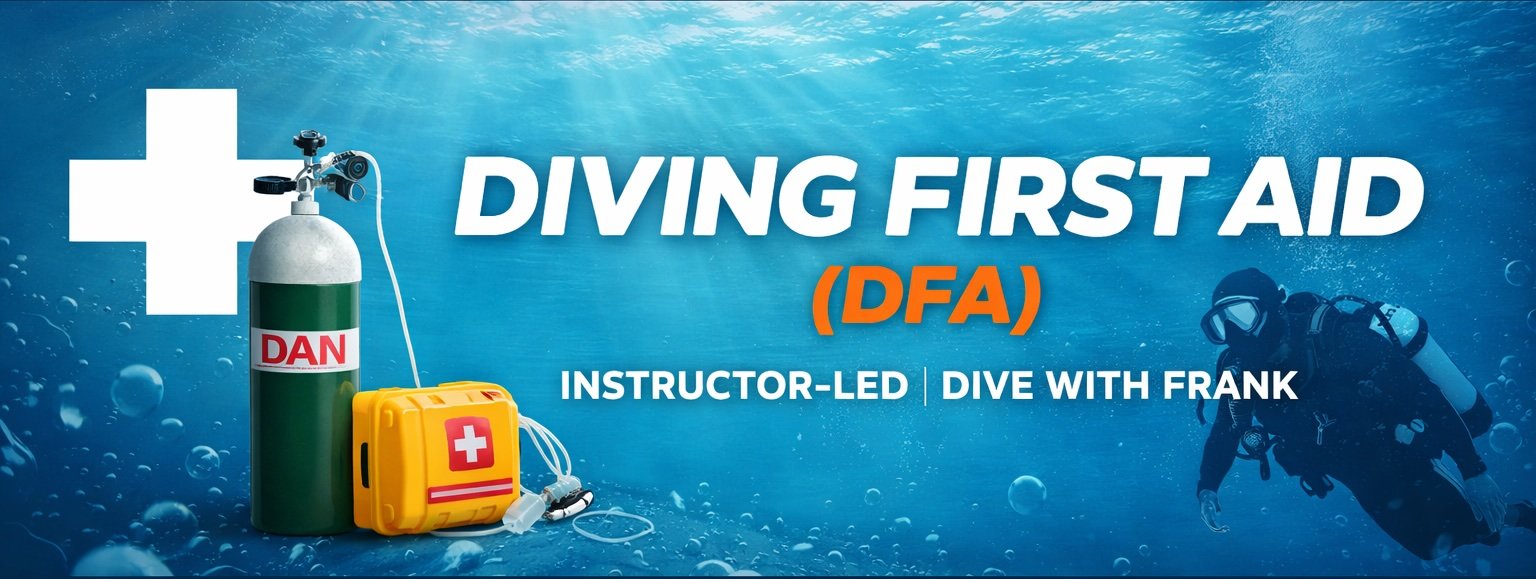
One quick note before we get into it: You may see DAN call this course Diving First Aid, DFA, or Diving First Aid for Professional Divers (DFA Pro). Do not let the naming make this harder than it needs to be. We are talking about DAN’s comprehensive diving first aid program.
Diving First Aid (DFA) is DAN’s most comprehensive first aid course for divers.
This is the class for people who want to be prepared, not just certified.
DFA brings CPR, first aid, emergency oxygen, neurological assessment, and hazardous marine life injury care together into one program. Instead of learning one piece of emergency response at a time, you learn how those pieces fit together when somebody is actually having a bad day.
Whether you dive recreationally, professionally, lead trips, work around the water, or simply want a much broader emergency-response toolkit, DFA gives you skills that can matter long before professional medical help arrives.
Why Take Diving First Aid?
Divers spend an enormous amount of time learning how to prevent emergencies underwater.
We practice alternate air-source use, emergency ascents, buddy procedures, buoyancy, gas management, and rescue skills because keeping the problem from happening is always Plan A.
But sometimes Plan A does not work.
When somebody reaches the surface injured, sick, confused, unconscious, or simply not acting right, there is no pause button while everyone waits for the ambulance.
The people already there become the first response.
DFA is designed for that gap. It gives you a structured way to assess what is happening, deal with immediate threats, provide CPR or first aid when needed, administer emergency oxygen for a suspected diving injury, gather useful neurological information, and continue providing care until professional medical help takes over.
The goal is not to turn you into a doctor.
The goal is to make you useful.
What Is Included in DFA?
DFA combines several major pieces of DAN first-aid training into one comprehensive course.
It includes the content from:
- DAN Basic Life Support: CPR & First Aid
- DAN Emergency Oxygen for Scuba Diving Injuries
- Neurological assessment for possible diving and other neurological injuries
- First aid for hazardous marine life injuries
That means we are not just talking about one particular diving accident.
You are building a broader first-aid foundation that can be useful on a dive boat, at a quarry, on a beach, during a trip, or somewhere nowhere near the water.
How the Course Works
DFA uses a blended-learning format.
The knowledge development is completed through DAN eLearning. You work through the academics at your own pace before we meet, covering the information behind the skills and the different emergencies you may encounter.
Then we get our hands on the equipment.
The skills portion is instructor-led and hands-on. We practice patient assessments, CPR, AED use, bleeding control, emergency oxygen equipment, neurological assessments, and injury-management skills in person.
You will work through scenarios, make decisions, use the equipment, and repeat skills when necessary.
Because reading the words “assemble the oxygen unit” and assembling the oxygen unit while somebody is depending on you are very different experiences.
This is where confidence gets built.
What You Will Learn
DFA covers a substantial amount of emergency-response material.
Skills and topics include:
- Scene safety and initial patient assessment
- Primary and secondary assessments
- CPR for adults, children, and infants
- One- and two-rescuer CPR
- Automated External Defibrillator (AED) use
- Management of an obstructed airway
- Recognition and management of shock
- Control of severe external bleeding
- Bandaging and wound management
- Tourniquet use
- Recognition of possible diving injuries
- Emergency oxygen equipment and administration
- Demand inhalator valves and nonrebreather masks
- Bag-valve masks and manually triggered ventilators
- Neurological assessment
- Collecting useful patient history and vital information
- Recognition and first aid for hazardous marine life injuries
- Response to other medical and traumatic emergencies
It is a lot of material.
That is also the point.
Real emergencies have an annoying habit of refusing to limit themselves to the one chapter you reviewed most recently.
Why the Neurological Assessment Matters
Some diving injuries can be subtle.
A diver may be awake, talking, and telling everyone they are fine while something is clearly not right. Weakness, confusion, balance problems, unusual fatigue, numbness, coordination problems, or changes in mental status can all provide important information.
DFA teaches you how to perform a neurological assessment and collect information that can be useful when the injured diver is transferred to emergency medical personnel.
Again, you are not diagnosing the diver.
You are recognizing that something may be wrong, documenting what you can observe, and giving the professionals who take over better information to work with.
Who Should Take This Course?
DFA makes obvious sense for people who have responsibility for other divers, but DAN does not restrict the course to dive professionals.
- Recreational divers
- Divemasters and instructors
- Dive trip leaders
- Boat crew and surface-support personnel
- Public safety divers
- Scientific and working divers
- Parents and family members who spend time around divers
- Anyone who wants a comprehensive set of practical first-aid skills
You do not need to be a dive professional to take DFA.
And because DFA incorporates the Basic Life Support and Emergency Oxygen material into the larger program, it can make a lot more sense than collecting each component separately if you already know you want the complete package.
DFA or Separate BLS and Emergency Oxygen Courses?
That depends on what you need.
If you simply need CPR and general first-aid training, DAN Basic Life Support may be all you are looking for.
If you already have qualifying current CPR training and specifically want to learn emergency oxygen for diving injuries, DAN Emergency Oxygen makes sense.
But if you want CPR, first aid, emergency oxygen, neurological assessment, and hazardous marine life injury training, DFA puts those pieces together.
You do not get extra points for taking the long way around.
DAN Oxygen Grant Program
There is another interesting benefit for qualified DAN members.
DAN members who hold current DFA or Emergency Oxygen training may be eligible to apply through DAN’s Oxygen Grant Program for assistance obtaining emergency oxygen equipment.
There are different grant paths depending on who is applying. DAN offers a matching program for qualifying dive professionals, dive stores, and dive facilities, and a full-grant program for certain nonprofit, public safety, academic, scientific, and similar organizations.
Certification does not automatically qualify someone for an oxygen unit. DAN determines eligibility and awards grants based on its current program requirements and the applicant’s circumstances.
If that program applies to you, I can point you toward DAN’s current grant information after class.
Training for the Day You Hope Never Happens
Nobody takes a first-aid class because they are hoping to use CPR next weekend.
The best outcome is that you keep renewing the certification and never have to use any of the serious stuff.
But if your buddy collapses on the dock, a diver surfaces with possible decompression illness, somebody gets badly cut, or a person starts showing neurological symptoms after a dive, that is a lousy time to wish you had paid more attention to emergency training.
DFA gives you a framework.
Look at what is happening. Deal with the immediate threats. Call for help. Use the equipment. Gather information. Keep providing useful care until somebody with a bigger medical bag takes over.
That is preparation.
Ready to Take DFA?
Diving First Aid is taught by Dive With Frank in private sessions and small groups, with plenty of time for hands-on practice, questions, scenarios, and repetition.
This is serious training without unnecessary pressure or ego.
You are allowed to make mistakes here. In fact, I would much rather have you make them with a training manikin and an oxygen kit sitting on a classroom table than discover them for the first time during a real emergency.