Who should take this course?
If you ask divers what their most memorable class was, a lot of them will say Rescue Diver. Not because it was easy, but because it mattered.
This course is where you stop just thinking about yourself underwater and start paying attention to the whole dive.
You’ll learn how to recognize problems early, manage stress in yourself and others, and step in calmly when something starts to go sideways. You become a better buddy, a more confident diver, and someone other people are genuinely glad to have in the water with them.
It’s a serious course, but it’s also a fun one. There’s focus, there’s problem solving, and yes, there’s plenty of laughter in between. Learning works better that way.
To enroll, you’ll need to be a PADI (Junior) Advanced Open Water Diver or qualifying equivalent, and you must have current CPR and First Aid training within the last 24 months. If you don’t have that yet, no problem. Frank teaches those too, and they can be completed alongside Rescue.
What will you learn?
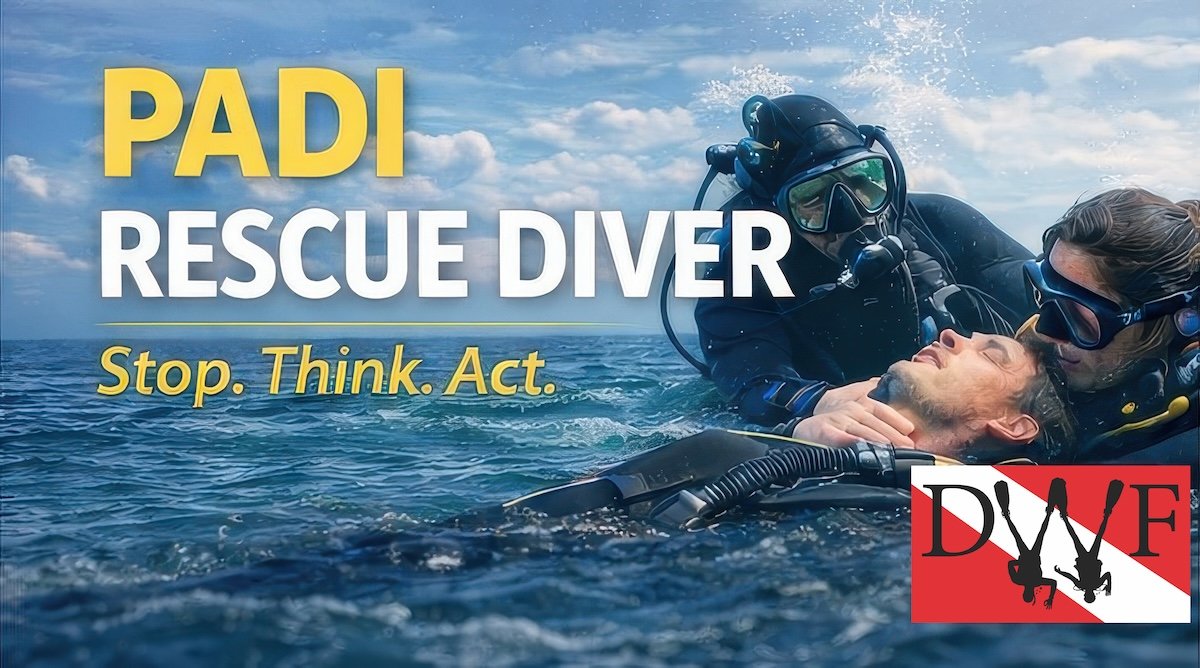
The PADI Rescue Diver course prepares you to deal with real-world dive problems, both minor and major, using practical, proven techniques.
Through knowledge development, skill practice, and realistic scenarios, you’ll learn what to look for, how to prioritize, and how to respond without rushing or panicking.
You’ll learn how to:
- Manage your own stress and perform self-rescue
- Recognize stress and problems in other divers early
- Handle emergency situations using proper procedures and equipment
- Assist panicked divers
- Rescue unresponsive divers at the surface and underwater
This course is about learning to stop, think, and act instead of reacting. Those skills don’t just make you safer. They make every dive better.
You may also be eligible to earn college credit for the Rescue Diver course. Ask Frank for details.
How can you start learning now?
This course starts with a conversation, not a fixed calendar slot.
Pricing is set. Scheduling is confirmed after we connect.
We’ll walk through your prerequisites, coordinate scheduling, and build a training plan that actually works with your availability and conditions.
Knowledge development is typically completed through PADI eLearning, followed by in-water sessions that focus heavily on realistic scenarios and practical application.
What scuba gear will you use?
You’ll use your standard scuba equipment along with additional tools used for rescue training.
This includes a pocket mask for in-water rescue breathing and training with oxygen units, floats, marker buoys, and other emergency equipment. You’ll also work with training aids such as CPR mannequins during certain exercises.
I’ll review gear requirements ahead of time so you know exactly what to bring, rent, or borrow.
How Long Will This Take?
Rescue Diver training typically includes one or two longer pool sessions focused on skills and scenarios, followed by at least one open water training day. Most classes are completed within the same week, depending on scheduling and conditions.
This course isn’t rushed. The goal is confidence, not checking boxes.
Start Your Training
This is where divers level up.
If you’re ready to become the diver others trust when things get interesting, this is the class.
Pricing is set. Scheduling is confirmed after we connect.