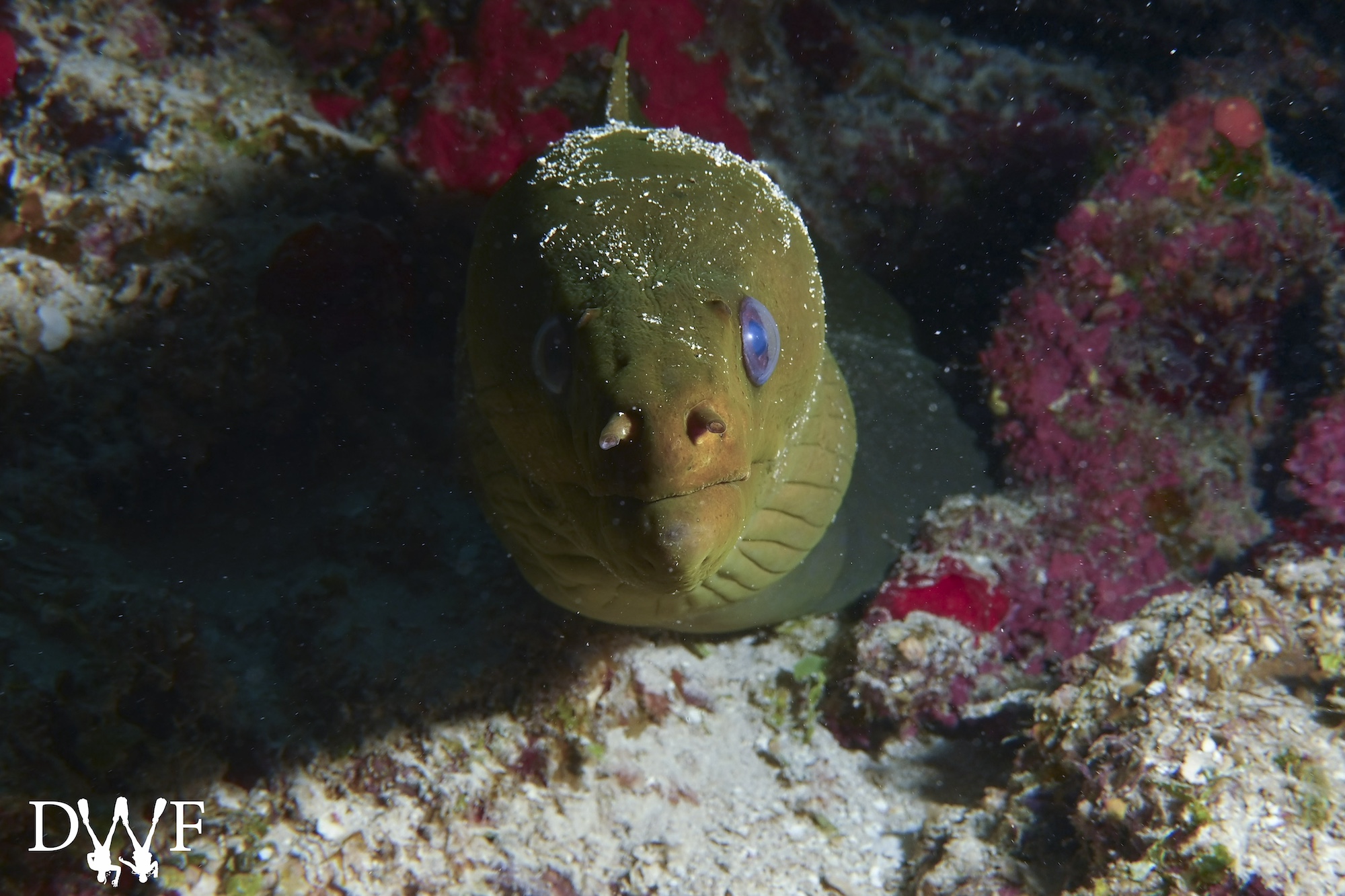

You have taken photos underwater before.
Some of them were pretty good.
Some of them were blue. Very blue. Maybe there was a fish-shaped blur in there somewhere if we are being generous.
The PADI Digital Underwater Photographer Specialty is about moving beyond lucky shots and learning to take photographs intentionally. You will work on positioning, composition, lighting, camera technique, buoyancy, and the little adjustments that turn “I took a picture” into “I meant to do that.”
You do not need a giant camera rig with enough lights and arms to resemble an underwater space station. We can work with the camera you actually dive with.
Who Should Take This Course?
If you keep coming home from dives wondering why your photographs do not look anything like what you remember seeing underwater, this is a good place to start.
You must be at least 10 years old and certified as a PADI (Junior) Open Water Diver or hold an appropriate qualifying certification from another recognized training organization.
You do not need previous photography training, and you do not need an expensive camera. A compact camera, action camera, or more advanced underwater system can all be useful training tools.
What matters more is that you want to understand why some photographs work and others do not.
The Camera Is Only Part of the Picture
It is really easy to look at somebody else’s underwater photographs and assume the secret is sitting in a shopping cart somewhere.
Better camera. Bigger strobe. Wider lens. More expensive housing.
Gear certainly matters, but underwater photography starts with the diver. If you cannot control your position, approach your subject without chasing it away, recognize where the light is coming from, or hold yourself still long enough to compose the image, a more expensive camera mostly gives you more expensive bad photographs.
That is one of the reasons underwater photography is such an interesting diving specialty. The camera gives you immediate feedback on skills that have nothing to do with photography.
Your buoyancy, trim, awareness, breathing, and ability to move deliberately all show up in the pictures.
What Will You Learn?
The course combines photography fundamentals with the realities of trying to use a camera while scuba diving.
During training, we will work on things such as:
- Choosing and setting up an underwater camera system appropriate for your goals.
- Using the PADI SEA method: Shoot, Examine, Adjust.
- Basic underwater composition and subject placement.
- Understanding how water changes color, contrast, and light.
- Reducing backscatter and other common underwater photography problems.
- Getting close enough to your subject to improve clarity and color.
- Using available light effectively.
- Positioning yourself for a photograph without touching or damaging the environment.
- Maintaining buoyancy and trim while operating the camera.
- Reviewing your photographs underwater and making useful adjustments instead of simply taking fifty more of the same bad shot.
The goal is not just to leave the course with better pictures from two dives. It is to give you a repeatable process for improving your photography every time you get back in the water.
Shoot. Examine. Adjust.
This may be the most useful idea in the entire course.
Take the photograph. Look at it. Then ask what needs to change.
Is the subject too small? Get closer. Is the image dark? Think about the available light or your camera settings. Is there a snowstorm of backscatter across the frame? Look at your distance, angle, and lighting. Is half the fish missing? That one is probably composition.
Then change something and take the picture again.
Digital photography makes this enormously useful because you do not have to wait until you get home to discover that every photograph from the dive has the same problem. The screen on the back of the camera can become a tiny underwater instructor if you actually pay attention to what it is telling you.
Get Close. Then Get a Little Closer.
Water is not doing your photograph any favors.
The farther light travels through water, the more color and contrast disappear. Suspended particles between you and the subject can also show up as backscatter, especially when artificial light hits them.
One of the simplest ways to improve an underwater photograph is often to reduce the amount of water between the camera and the thing you are trying to photograph.
That does not mean chasing a turtle across the reef or planting your knees in the coral so you can get six inches closer. Good underwater photography still has to be good diving.
We work on approaching subjects calmly, choosing a useful angle, getting into position without damaging anything, and recognizing when the correct photograph is the one you do not take.
Your Buoyancy Is Part of the Camera System
A camera adds task loading. Suddenly you are thinking about framing, settings, light, the subject, and whether you actually pressed the shutter while you are still supposed to be managing the dive.
Your depth did not stop mattering because a shark swam past.
Neither did your gas supply, buddy, navigation, or the reef underneath you.
We will spend time working on taking photographs while maintaining control of your position in the water. Ideally, you should be able to stop where you want, compose the photograph, take it, and move away without grabbing the bottom or using the environment as a tripod.
If photography exposes a weakness in your buoyancy or trim, that is useful information. We fix the diving problem instead of learning how to compensate for it with the camera.
How Does the Course Work?
The PADI Digital Underwater Photographer Specialty includes knowledge development and two open-water photography dives.
I also like to spend some time with the camera before the open-water dives when the schedule and equipment make that practical. That gives us a chance to look at controls, settings, housing operation, handling, and basic camera skills somewhere other than the middle of an actual dive.
Then we go diving.
The first photographs give us something to work with. We review them, figure out what is working and what is not, make adjustments, and go back into the water with specific things to improve.
That feedback loop is where the class becomes useful. You are not just listening to somebody talk about photography. You are taking pictures, looking at the results, changing what you are doing, and seeing what happens next.
What Camera and Gear Will You Need?
You will need standard scuba equipment appropriate for the dive site and an underwater camera system.
If you already own a camera, great. Bring it. There is a lot of value in learning with the equipment you are actually going to use after the class.
If you are still shopping for a camera, talk to me before buying a pile of equipment because somebody on the internet said you needed it. We can talk about what you want to photograph, how often you expect to use the camera, how much complexity you actually want underwater, and what kind of system makes sense.
Whatever camera you use, make sure the housing, seals, batteries, memory card, and controls are ready before the dive. Opening a housing beside the water because we forgot to charge the battery is not my preferred introduction to underwater photography.
Where Do We Do the Dives?
Digital Underwater Photographer is offered by request because the best training location depends on what you want to accomplish, the equipment you are using, and the conditions available to us.
We can use local confined and open-water environments, or the specialty can sometimes fit naturally into a DWF trip when the location and schedule make sense.
Clear tropical water is wonderful for photography, but it is not required to learn photography. More challenging local conditions can actually teach you quite a bit about getting close, managing light, holding position, and working with the environment you have instead of the environment you wish you had.
Can This Count Toward Advanced Open Water?
Yes. The second dive of the PADI Digital Underwater Photographer Specialty may be eligible for credit as an Adventure Dive toward Advanced Open Water Diver.
If you are working toward both certifications, tell me before we start so we can make sure the training is structured and documented correctly.
Ready to Take Better Pictures?
Digital Underwater Photographer is currently offered by request. We will coordinate the training around your camera, your experience, your goals, and a location that gives us a useful environment to work in.
Ask Frank about Digital Underwater Photographer and tell me what camera you are using, what kind of diving you normally do, and what you would like to improve.
If your current photography strategy is “take 300 pictures and hope four of them are good,” we can probably improve on that.
You can also browse all DWF specialty courses if you are still deciding what you want to learn next.