
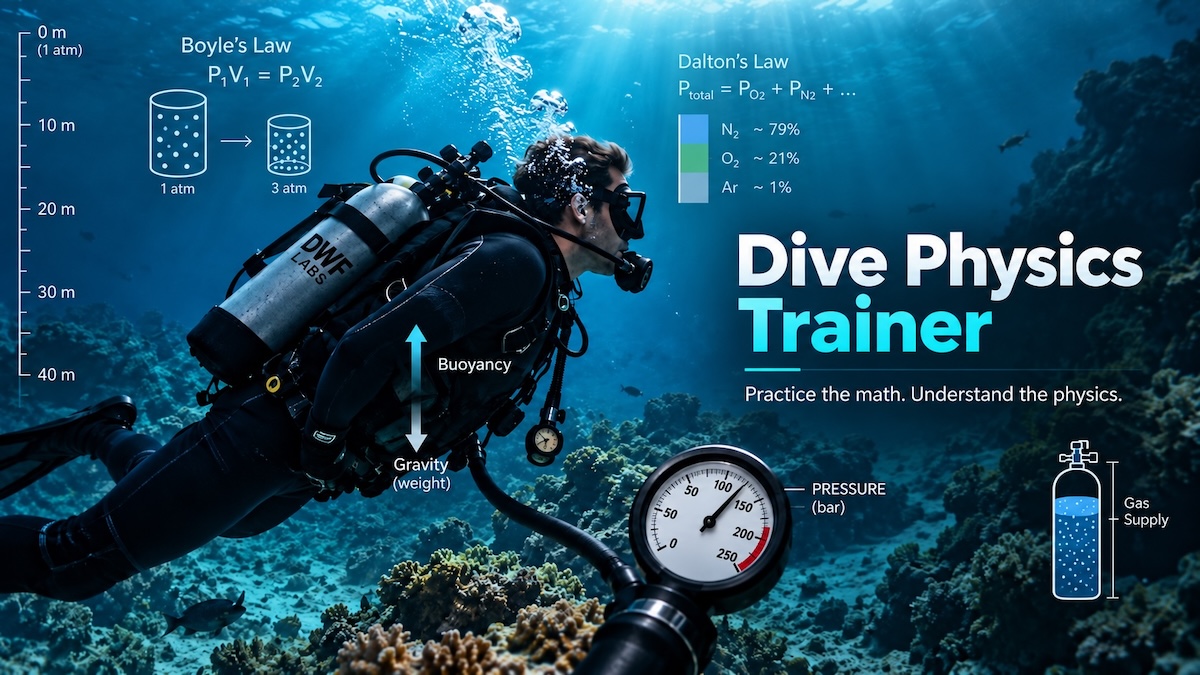
Practice the math. Understand the physics. Stop memorizing your way through it.
Scuba diving is full of physics.
Pressure changes with depth. Gas volume changes with pressure. Cylinders hold different amounts of gas. Buoyancy depends on displacement. Oxygen behaves differently as partial pressure changes.
You can memorize a handful of formulas and probably get through a test.
Or you can actually understand what is happening.
The DWF Dive Physics Trainer is built for the second option.

Dive Physics Trainer
Practice the reasoning behind dive physics, not just the arithmetic.
Build / Print Exam
Generate a reproducible exam and print either the student version or the instructor answer key using DWF Labs Core.
Student Exam Code: safe to share with students. Instructor Answer Key Code: keep it private if you do not want students to retrieve the answers and worked solutions.
Load a Problem, Exam, or Answer Key Code
Physics Constants
These are the reference values used by this trainer. You do not need to memorize them to use the trainer.
Pressure & Depth
| Surface pressure | 1 ATA |
| Salt water | +1 ATA / 33 ft |
| Fresh water | +1 ATA / 34 ft |
| Salt water | +1 ATA / 10 m |
| Fresh water | +1 ATA / 10.3 m |
Water Density / Buoyancy
| Salt water | 64 lb/ft³ |
| Fresh water | 62.4 lb/ft³ |
| Salt water | 1.03 kg/L |
| Fresh water | 1.00 kg/L |
Gas Laws
| Boyle’s Law | P₁V₁ = P₂V₂ |
| Dalton’s Law | PP = fraction × absolute pressure |
| Absolute temperature | K = °C + 273.15 |
| Absolute temperature | °R = °F + 459.67 |
Cylinder Gas Quantity
| Imperial | gas = rated gas × current pressure ÷ rated pressure |
| Metric training approximation | surface-gas L ≈ cylinder L × bar |
| Important | Use the cylinder information stated in the problem |
Gas Consumption
| Rate at depth | surface rate × absolute pressure (ATA) |
| Gas used | rate at depth × time |
| Duration | available gas ÷ rate at depth |
Useful Conversions
| 1 ft³ | 28.3168 L |
| 1 m³ | 1000 L |
| 1 m³ | 35.3147 ft³ |
| 1 kg | 2.20462 lb |
What’s New
Problem and exam codes now stay readable across supported themes and WordPress theme styling.
Hints and worked solutions now replace their own loading message instead of leaving a stale loading notice behind.
A PADI IE Physics Practice Example is now available in Practice Exam setup. It uses original DWF questions and is clearly identified as an unofficial practice configuration rather than an exact PADI exam replica.
Theme readability has been improved throughout Practice, Practice Exam, Study Status, and tool dialogs. Text and controls now remain clear in Ocean, Deep Sea, and High Contrast.
Practice, Practice Exam, and Study Status now switch cleanly between dedicated views. Moving between practice, exams, and progress keeps the current tool state without stacking multiple sections on the page.
Practice Exam and Build / Print Exam now offer 10, 20, 30, 50, or a custom number of questions up to 100.
Practice Exam now makes it clear that a full review is available after completion, with step-by-step walkthroughs for missed questions.
Printable exams continue to use separate student and instructor codes. Share the Student Exam Code freely; keep the Instructor Answer Key Code private when you do not want students to retrieve the key.
Problem and exam codes remain compact and easy to copy or type.
Additional behind-the-scenes reliability improvements prepare the trainer for broader public use.
Display Settings
Choose a comfortable view. Your choice is saved in this browser.
Theme
Text Size
Motion and Decoration
Why I Built This
This one is personal.
By the time I went through Divemaster training, dedicated dive physics had essentially been removed from the DM curriculum. I didn’t get exposed to real dive theory until I was preparing for my Instructor Development Course (IDC)—and frankly, it would have served me a lot better if I’d seen it much earlier in my training.
Waiting until you’re on the doorstep of becoming an instructor to suddenly master dive theory is doing it the hard way.
When I sat down to prep for the IDC, I worked through Dive Theory Online, reviewed the formulas, and tried to grind through practice problems until the concepts became second nature. But I ran into a wall:
There just weren’t that many good examples available.
I could find explanations.
I could find formulas.
I could find a few basic practice questions.
What I really wanted was something that could say:
“Okay. Here’s another one. And then another. And another. Change the numbers. Change the units. Change the situation. Make me decide which law applies. Let me screw it up. Show me why I screwed it up. Then give me another one.”
So, years later, I built that tool—not just for IDC candidates, but so divers coming up through the ranks can start building physical intuition long before they’re staring down an instructor exam.
This Isn’t Just a Calculator
A calculator asks you for numbers and gives you an answer.
The Dive Physics Trainer gives you a problem and asks you to figure it out.
Depending on the problem, you may have to:
- Recognize which physical principle applies
- Separate useful information from irrelevant information
- Normalize pressure or volume
- Convert units
- Reason through a multi-step problem
- Decide whether your answer even makes physical sense
And if you get stuck, you can ask for a hint.
If you get it wrong, you can work through the reasoning.
The goal isn’t simply to arrive at the right number. The goal is to understand why it’s the right number.
What Can You Practice?
The current trainer includes problems involving:
- Pressure and depth
- Boyle’s Law and pressure-volume relationships
- Buoyancy and displacement
- Lift systems and applied buoyancy
- Cylinder and gas-volume calculations
- Gas consumption and duration
- Dalton’s Law and partial pressure
You can work in metric or imperial units, fresh water or salt water, and across several difficulty levels.
You can also choose how you want to answer:
- Full Answer: Makes you work the problem yourself.
- Multiple Choice: Gives you possible answers, including distractors based on the kinds of mistakes divers actually make.
- Mixed: Gives you a little of both.
Want Something More Like a Test?
There is a dedicated Practice Exam mode.
Choose the exam length, work through the questions without hints or worked solutions, and get your review when you’re finished.
Miss something? You can open the question afterward and walk through the solution step by step.
I’ve also included a PADI IE Physics Practice Example preset for people preparing for instructor-level dive theory.
A very important distinction: It is not an official PADI exam. The questions are original DWF Labs problems. The preset isn’t endorsed by PADI and isn’t intended to reproduce the current Instructor Examination question-for-question. It is simply a convenient way to practice the kind of dive-physics reasoning an instructor candidate should be comfortable doing.
Practice Until It Stops Feeling Like Math
One of the interesting things about dive physics is that eventually the formulas start disappearing.
Not literally.
But after enough problems, you stop looking at a question and thinking:
“Which equation am I supposed to memorize for this?”
You start thinking:
“Of course the volume gets smaller. The pressure increased.”
Or:
“That answer can’t possibly be right.”
Or:
“Wait. That’s gauge pressure. I need absolute pressure.”
That’s the point where you’re no longer just solving test questions. You’re developing physical intuition. And that’s much more useful underwater.
For Divemasters, Instructor Candidates, Students, and Curious Divers
You don’t need to wait until you’re prepping for an instructor exam to learn this stuff—in fact, you shouldn’t.
Maybe you’re a Divemaster candidate who wants to get ahead of the game before you hit an IDC.
Maybe you’re headed toward an IDC right now.
Maybe you’re already an instructor and haven’t touched Boyle’s Law algebra in ten years.
Maybe you’re an Open Water or Advanced student who just wants to know what all this pressure stuff actually means.
Or maybe you’re the sort of person who sees a button labeled Generate Problem and thinks: “Well, obviously I’m pushing that.”
You’re my people.
This Is a Beta
The Dive Physics Trainer is currently a DWF Labs Beta.
That means the core tool is working, but I’m still testing it across devices, browsers, problem combinations, and real-world use.
If something looks wrong, a question seems ambiguous, or you get an answer that makes you say, “Frank, there is no freaking way that’s right,” I genuinely want to know about it.
Spot something wrong? Think something could be better? Tell me about it.
Physics is unforgiving. My software shouldn’t be.
One Last Thing
This tool is for education and practice.
It doesn’t replace your instructor, your training agency’s current materials, required coursework, standards, dive planning procedures, or professional judgment. It also isn’t affiliated with or endorsed by PADI or any other training organization.
It’s just the practice tool I wish I’d had when I was coming up through my training.
Knock yourselves out, folks.