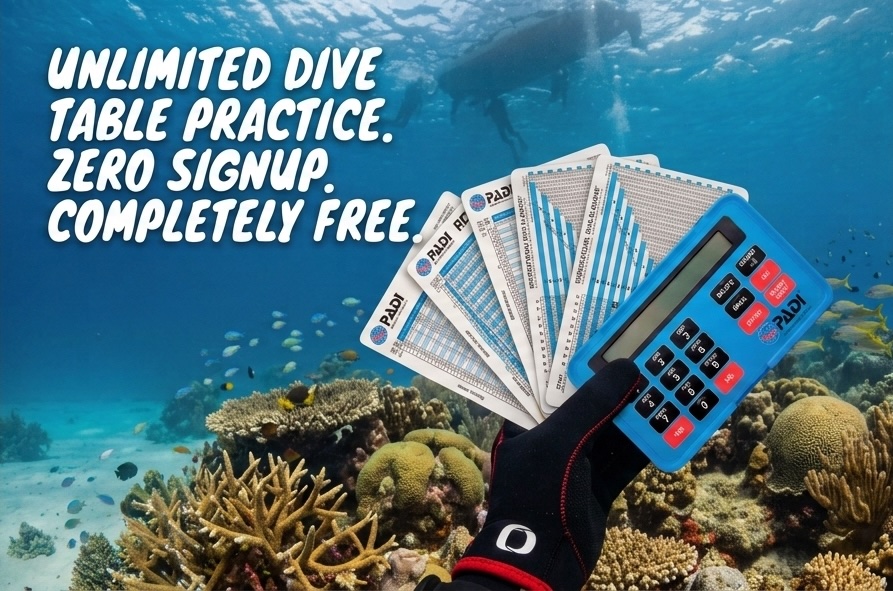
Part of the DWF Training Lab
Free Recreational Dive Planner Practice for Scuba Students and Instructors
If dive tables make your brain itch a little, you’re not alone.
For years I’ve watched students get nervous the moment someone says, “Now we’re going to learn the dive tables.” The funny part is that most people aren’t struggling with math. They’re struggling with remembering which table to use, what gets rounded, and what happens next.
That’s exactly why I built this.
This free educational tool generates thousands of randomized practice scenarios for students learning to use the official Recreational Dive Planner (RDP®). Each exercise focuses on real table-reading skills—including pressure groups, surface intervals, repetitive dives, residual nitrogen time (RNT), actual bottom time (ABT), total bottom time (TBT), minimum surface intervals, and maximum bottom time—while assuming you are working from your own official Recreational Dive Planner.
Every problem is automatically checked, fully explained, and assigned a unique problem code so instructors and students can recreate the exact same scenario later.
For best results, use this trainer alongside current official training materials and the official printed Recreational Dive Planner.
RDP Trainer
Practice Recreational Dive Planner lookups, surface interval credit, residual nitrogen time, and repetitive dive math.
Loading practice console...
What's New
Recent improvements to RDP practice and classroom use.
- Multi-Dive practice now works through a complete three-dive day with two surface intervals.
- Successive dives are generated shallower and within repetitive-dive depth limits.
- Multi-Dive explanations more clearly show when Table 2 credit is enough and when the W/X/Y/Z special rules control the interval.
- Metric repetitive-dive accuracy and consistency have been improved.
- Multi-Dive problem codes preserve all three dives so instructors and students can reproduce the whole exercise.
- Older two-dive Multi-Dive codes are retired with a clear user-facing message.
- Moving to the next problem now keeps the practice console visually stable while the new problem loads.
- Problem Codes are now substantially shorter and easier to copy, type, and share.
- Behind-the-scenes reliability improvements strengthen classroom and practice use.
Display Settings
Choose a comfortable view. Your choice is saved in this browser.
Theme
Text Size
Motion and Decoration
Who This Trainer Is For
- Open Water students who want extra practice before class, quizzes, or knowledge reviews.
- Certified divers who want to refresh old dive table skills.
- Scuba instructors and divemasters who want reproducible practice problems, worksheets, answer keys, and classroom examples.
What You Can Practice
- Pressure Groups using Table 1.
- Surface Interval Credit using Table 2.
- Residual Nitrogen Time (RNT), Actual Bottom Time (ABT), and Total Bottom Time (TBT).
- Repetitive Dive Planning using Table 3 and Table 1 together.
- Minimum Surface Interval calculations.
- Maximum No-Decompression Limits (NDL) for first dives (Table 1) and Adjusted NDLs for repetitive dives (Table 3).
- Easy, Standard, Hard, and Advanced difficulty levels.
- Unlimited randomized practice problems.
How To Use This Trainer
- Grab your printed Recreational Dive Planner.
- Select the type of problem you want to practice.
- Solve the problem using your RDP exactly as you would during class.
- Check your answer.
- If you miss one, read the explanation and try again.
- Repeat until the process becomes second nature.
Why Learn Dive Tables?
Dive computers are fantastic tools. I dive with one every single time, and if you’re exploring profiles much below 60 feet, relying on digital instrumentation is simply smart, conservative diving. However, learning to navigate the physical tables isn’t about replacing your computer; it’s about lifting the hood to understand exactly what that machine is calculating on your wrist.
When you fundamentally grasp concepts like pressure groups, repetitive exposures, residual nitrogen loading, and surface interval credit, you stop just blindly pushing buttons. You begin making truly informed decisions about your safety margins. Most students don’t need another dry classroom lecture to cross this bridge. They just need repetitive, practical practice to build confidence, and this trainer exists to give you those exact reps.
For Scuba Instructors
The trainer also includes instructor-focused tools including reproducible problem codes, printable worksheets, answer keys, and classroom practice activities.
If you’re an instructor and have ideas that would make this more useful in the classroom, I’d genuinely love to hear them.
Send me feedback or report a trainer issue here.
Frequently Asked Questions About the RDP
Is this an official tool to plan my open water certification dives?
Absolutely not. This trainer is strictly an educational exercise generator designed for classroom practice, self-study, and building muscle memory. Never use this application to plan or execute real-world dives. Always refer to your official training materials, standard plastic tables, and your dive computer when you are headed to open water.
Why do my answers sometimes differ slightly from the trainer’s step-by-step breakdown?
The number one culprit is usually rounding. Remember the core rule of the Recreational Dive Planner: when your exact depth or time isn’t explicitly listed on the chart, you must always round up to the next deepest depth or the next higher time interval to keep your calculations conservative. Check the detailed solution text below your graded answer to see exactly which row or column the engine rounded to.
Do I need to memorize the numbers on the dive tables to pass my class?
No, nobody expects you to memorize the rows. The RDP is an open-book, pattern-recognition tool. The instructions are literally printed right on the plastic. The goal of using this trainer isn’t to commit the numbers to memory; it’s to develop a comfortable habit of navigating the grid so you don’t get flustered during your classroom sessions or exams.
If modern smartwatches handle decompression math, why do instructors still teach the table?
Because a smartwatch or wrist computer is a black box that hides the calculation engine. If you only look at the final digital display, you don’t actually see how a surface interval reduces your nitrogen profile or how a repetitive exposure changes your limits. Walking through the table manual turns abstract nitrogen accumulation into a visible system you can actually watch change in real time.
Planned DWF Training Lab Features
- Custom instructor worksheets
- Printable multiple-choice quizzes
- Expanded classroom discussion activities
- Achievement badges
- Nitrox table practice
- Additional DWF Training Lab learning tools
Important Disclaimer
The Dive With Frank Dive Table Trainer is an independent educational practice tool.
It is designed for classroom practice, self-study, and skill development only. It is not a dive planning application and must never be used to plan or conduct actual dives.
Always use current official training materials, your instructor’s guidance, your dive computer, official dive tables, and conservative judgment when planning real dives.
Trademark Notice
Dive With Frank is independently owned and operated by a PADI Instructor.
This educational project is not sponsored by, affiliated with, endorsed by, reviewed by, or approved by PADI, DSAT, or their affiliates.
PADI®, Recreational Dive Planner®, and RDP® are trademarks and/or registered trademarks of their respective owners. References are used solely to identify the training materials this educational practice tool is designed to complement.