Diving should be fun. Training should not feel like an ordeal, a race, or a competition to see who can get through the skills fastest. You are not trying to beat the person next to you, and nobody gets extra points for learning something on the first try.
Training can challenge you. Sometimes it should. But challenge and stress are not the same thing. Good training gives you room to work through something, understand it, practice it, and eventually reach the point where the thing that seemed difficult starts to feel almost routine.
I have been teaching scuba for more than a decade and have helped divers earn more than 500 certifications along the way. These days I teach independently, usually in very small groups, but all of those years, classes, students, mistakes, successes, and occasional underwater surprises have shaped the way I teach. If you want the résumé version, you can find that on my About Me page. This page is about what all of that experience has taught me.
Calm Comes First
Calm divers make better decisions. They conserve gas, communicate better, pay attention to what is happening around them, and notice little problems before those problems start collecting friends.
That does not mean good divers never get surprised, uncomfortable, or stressed. Diving occasionally throws weird things at us. A leaking mask. A fin strap that suddenly decides it has had enough. A descent that does not go the way you planned. Visibility that looks like somebody dumped chocolate milk into the quarry.
The goal is not to create a diver who never encounters a problem. The goal is to create a diver who can stop, breathe, think, and deal with it. I do not manufacture stress during training just to see what happens. We build comfort deliberately, layer by layer, until being calm underwater starts to feel normal.
Once that happens, the fun part gets a whole lot easier.
The Standard Does Not Change. The Pace Can.
Everyone learns differently. One student may clear a mask once and wonder why anybody ever worried about it. Another may need ten tries before their brain finally accepts that water touching their nose is not, in fact, the end of civilization.
Neither student gets a different standard. If a skill is required, you need to be able to perform it. I am not going to wave something through because we are running late, because everyone else finished, or because checking the box would be easier.
What can change is how we get there. We can slow down. We can break a skill into smaller pieces. We can change the explanation. We can practice it again. Sometimes we just need to come at the same problem from a completely different direction.
Buoyancy is a perfect example. Most people do not put on scuba gear and instantly become perfectly balanced underwater. It takes repetition and awareness, which is a big part of why I think buoyancy deserves focused practice instead of being treated like something you either magically understand or you do not.
The goal is competence, not speed. The stopwatch does not get to decide whether you are ready.
I Have Probably Seen This Before
More than 500 certifications represents a lot of time working with people through different classes, different skills, and a whole lot of different problems. That experience is much more useful to me than the number itself.
At this point, it is pretty unlikely that you are going to show up with a problem I have never seen before. Trouble equalizing. Mask anxiety. Descents that keep going sideways. Buoyancy that refuses to cooperate. Task loading. Equipment problems. Confidence problems. People getting inside their own heads. I have worked through a lot of this stuff with a lot of divers.
And if I have not seen your particular problem in a student, there is a decent chance I did some version of it myself back in the day.
That does not mean I have seen everything. Divers remain remarkably creative. But experience gives me a pretty deep toolbox to reach into before we start calling something impossible.
If You Do Not Understand It, I Need to Explain It Better
I have had a lot of years to think about how to explain scuba. Some concepts sound complicated when you first encounter them. Pressure. Buoyancy. Gas laws. Decompression. Sometimes the textbook explanation works perfectly. Sometimes it absolutely does not.
If I explain something and you do not understand it, my first reaction should not be that you failed to understand. Teaching it is my job. My job is to find another way to explain it.
Maybe we need a better analogy. Maybe we need to draw it. Maybe we need to move some objects around on a table. Maybe you need to see it happen in the water. Over the years I have collected a lot of different ways to break complicated ideas into pieces that make sense.
I know how powerful that can be because it happened to me too. For years I could answer buoyancy questions without really feeling like I understood the physics underneath them. Then Archimedes finally clicked, and something that had always felt complicated suddenly became intuitive.
That moment when somebody looks at me and says, “Oh. Now I get it,” is one of my favorite parts of teaching. Once you understand the idea underneath a skill, there is a pretty good chance you will remember it long after the class is over.
Also, my dad jokes are absolutely on point. Consider those part of the instructional toolbox.
Mistakes Tell Me Something
Students make mistakes. Instructors make mistakes. Experienced divers make mistakes. What interests me is why the mistake happened.
Sometimes a student does something I never expected because they understood my instruction differently than I intended. From their point of view, what they did may have made perfect sense. That is useful information for me as an instructor.
I do not just want to correct the motion and tell you to do it again. I want to understand what you thought was supposed to happen. If we can find the disconnect, we can fix the understanding underneath it instead of just treating the symptom.
Every student I teach adds something to the toolbox I bring to the next one. After more than a decade of teaching, I am still learning too.
Breaking the Chain Early
Most dive emergencies do not appear out of nowhere. They grow.
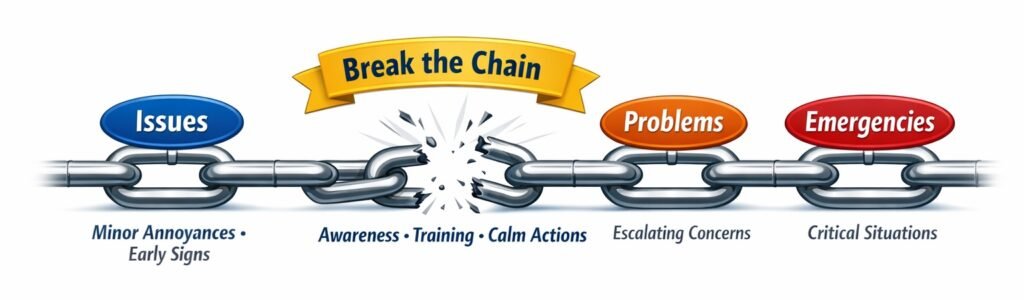
A small issue gets ignored. Then another issue appears. Task loading increases. Stress follows. Communication gets worse. Eventually somebody is managing an emergency that started several steps earlier.
My teaching philosophy lives upstream. I want divers to recognize the first few links in that chain while the problem is still small, boring, and easy to solve.
That might mean noticing your gas supply sooner, stopping a descent that is not going well, recognizing that your buddy is uncomfortable, fixing a buoyancy problem before it becomes an uncontrolled ascent, or simply being willing to call a dive when something does not feel right.
This way of thinking becomes even more important as divers progress. It is a major part of Rescue Diver training, where recognizing a developing problem early is usually a whole lot better than waiting until you have an emergency to solve.
We do not wait for the last link and then congratulate ourselves for surviving it. We learn to break the chain early.
I Want Divers Who Think
Early in training, I am going to give you a lot of direction. That is part of learning. You need structure while you are building the skills and experience to make good decisions for yourself.
But I do not want you waiting forever for an instructor to tell you what happens next.
As you progress, I want more of the dive to become yours. I want you checking your own gas without being reminded. I want you thinking about your depth, time, buoyancy, navigation, buddy, conditions, and what happens next. I want you recognizing when something has changed and deciding what to do about it.
I get to watch that transition happen in real classes. During one Advanced Open Water weekend at Lake Hydra, the individual skills mattered, but the bigger lesson was watching students begin to solve problems, pay attention, and take more ownership of their dives. That is what advanced training should actually mean.
The certification card says you completed the course. Becoming a diver means learning to think underwater when nobody is standing next to you holding a clipboard.
Small Groups by Design
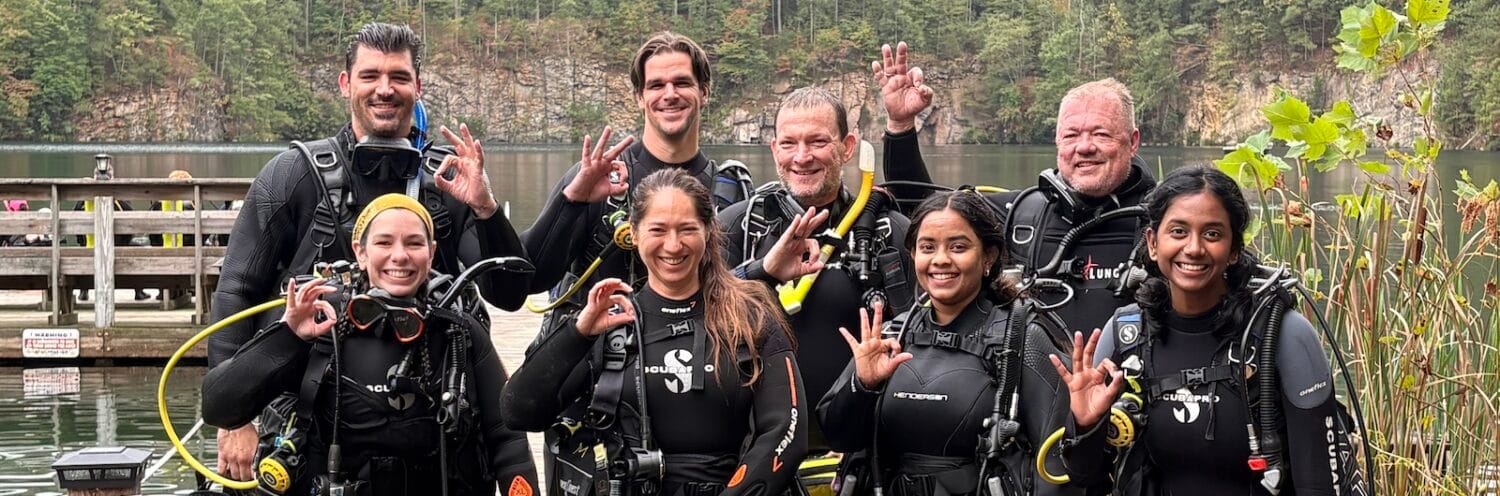
I keep class sizes small on purpose. Teaching independently gives me the freedom to be very intentional about that.
Smaller groups mean more time practicing, clearer feedback, and enough breathing room to stop and work through something when somebody needs it. I can watch what you are actually doing instead of simply making sure everybody made it to the other end of the pool.
Most importantly, small groups let me teach the diver standing in front of me instead of teaching some imaginary average student. That approach starts from the very beginning in Open Water training and carries through the rest of the way you choose to grow as a diver.
That is not a side effect of the way Dive With Frank operates. It is part of the design.
Straight Answers, Up Front
Trust matters before we ever get in the water.
I have signed up for classes that sounded reasonable until the add-ons started stacking up. Pool fees. Extra dives. Gear charges. Suddenly the number in your head was not the number on the receipt. That never sat right with me.
When you train with Dive With Frank, I want you to understand what you are signing up for, what is included, what is expected of you, and what the training is going to look like before we start. If you have questions, ask them. If something is unclear, I would rather explain it now than have you wondering about it later.
I expect students to trust me underwater. Being straightforward with them on land seems like a pretty reasonable place to start.
Is This the Right Fit?
This approach works best for people who want to learn skills thoroughly, understand why they are doing what they are doing, become genuinely comfortable underwater, and eventually take ownership of their dives.
You do not need to arrive fearless. You do not need to be naturally athletic. You do not need to already know the secret handshake of the scuba tribe. You do need to want to learn.
If you are looking for the fastest possible certification with the least possible effort, I may not be the instructor you are looking for. And that is okay. There are a lot of ways to learn to dive, and choosing the right instructor matters. I have written more about that in Stop Shopping for Logos. Start Shopping for Leadership.
I want to create divers who are comfortable, competent, curious, and capable of making good decisions when there is nobody standing beside them telling them what to do.
There are many ways to teach scuba. This is mine.
If this sounds like the way you want to learn, start with How Do I Get Scuba Certified?, take a look at Upcoming Classes, or browse the Frequently Asked Questions.
Still not sure what makes sense? Ask me. We can figure that out before anybody starts assembling scuba gear.