The Ocean Problem We Tried to Solve With Liquid Lungs
The bizarre science of liquid breathing, deep diving, and humanity’s stubborn refusal to accept that we are not fish.
The first time I watched The Abyss, I was not a diver yet.
So when the movie got into gas mixtures, pressure, deep diving, underwater habitats, and liquid breathing, a lot of it landed in my brain as high-quality science fiction technobabble.
Cool technobabble.
Beautiful technobabble.
James Cameron technobabble, which automatically means somebody probably spent six months making sure the plumbing looked right.
But still. I did not have the background to know what was real and what was movie magic.
Then I became a diver.
And eventually I rewatched The Abyss with a very different reaction:
Wait a minute. A disturbing amount of this is actually grounded in real diving science.
Not the aliens.
Probably not the underwater glow worm thing.
And I remain suspicious of any workplace where Ed Harris is expected to save humanity while soaking wet and emotionally devastated for what appears to be several consecutive fiscal quarters.
But the liquid breathing idea?
That part is not pure fantasy.
It is weird.
It is horrifying.
It is wildly impractical for normal diving.
But it is not nonsense.
Which raises one of the most fascinating questions in underwater science:
Could humans actually breathe liquid?
The Gas Density and Pressure Problems of Deep Scuba Diving
Every piece of scuba equipment exists because humans are trying to survive somewhere we were never designed to be.
We are air-breathing mammals.
We evolved to walk around on land, breathe a nice boring atmosphere, complain about humidity, and occasionally make poor decisions at buffets.
The ocean does not care.
The moment we go underwater, we have to bring our own breathing gas with us. At recreational depths, that works beautifully. A tank, a regulator, some training, a decent buddy, and suddenly we get to visit the ocean on its terms for a little while.
But the deeper we go, the more complicated the relationship becomes.
Pressure increases.
Gas density increases.
Breathing takes more effort.
Nitrogen starts acting funny.
Oxygen becomes both necessary and potentially dangerous.
Decompression obligations start piling up like an angry bar tab.
And your lungs, which are amazing at sea level, become part of the engineering problem.
That is the basic ocean problem.
Gas lets us dive.
Gas also limits how far, how long, and how safely we can do it.
The Insane Science of Perfluorocarbon (PFC) Liquid Ventilation
At some point, scientists and military researchers started asking a question that sounds like it escaped from a fever dream:
What if we stopped breathing gas?
Not forever.
Not as a lifestyle choice.
Not because some tech billionaire wants to disrupt lungs.
But for extreme environments where gas becomes a problem.
What if, instead of filling the lungs with air or another breathing gas, we filled them with an oxygen-rich liquid?
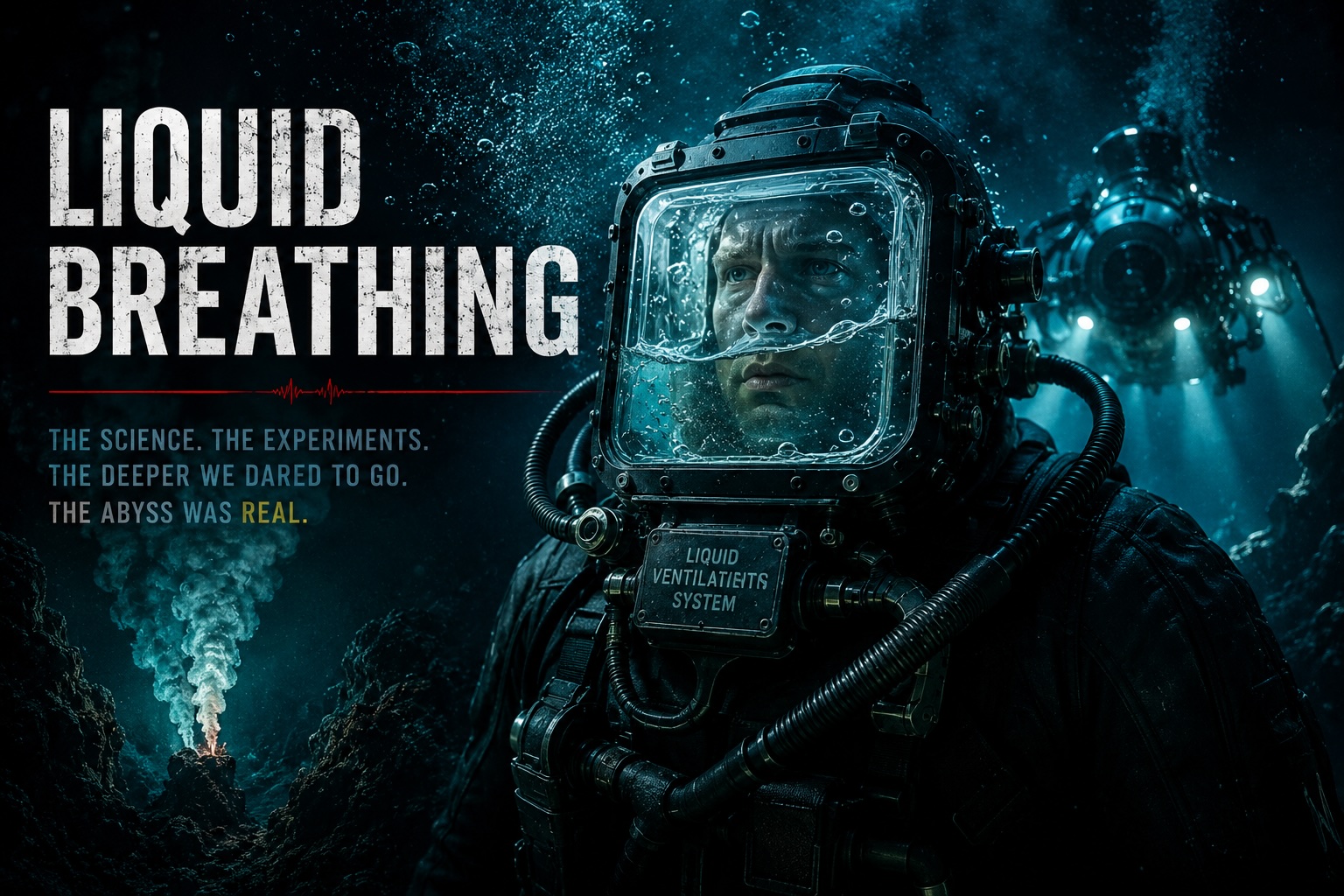
That is the basic idea behind liquid breathing.
The liquid usually discussed is a type of perfluorocarbon, often shortened to PFC. These are synthetic liquids that can dissolve large amounts of oxygen and carbon dioxide. They are chemically unusual, biologically interesting, and exactly the kind of thing that makes you realize scientists are both brilliant and deeply unsettling people.
The idea is not that you take a casual sip of magic scuba juice and become Aquaman.
The idea is that your lungs could be filled with a specially prepared oxygenated liquid that allows gas exchange to continue across the lung tissue.
Oxygen goes in.
Carbon dioxide comes out.
In theory.
In practice, the details get ugly fast.
How The Abyss Merged Real Ocean Science with Movie Magic
This is where The Abyss becomes so much cooler after you become a diver.
When the movie introduces liquid breathing, it feels like peak science fiction. A diver needs to go incredibly deep, deeper than normal gas breathing would allow, so the team uses an experimental liquid breathing system.
As a non-diver, I watched that and thought, “Neat movie idea.”
As a diver, I watch it and think, “Oh no. They were actually playing with real concepts.”
The famous rat scene was not just a special effect. The movie used real oxygenated breathing liquid for that scene. It remains one of the most memorable, uncomfortable, and controversial moments in the film.
And honestly, that discomfort is part of why the scene works.
Because every instinct in your body understands one thing:
Lungs are for air.
Watching an animal breathe liquid does not feel magical.
It feels wrong.
It feels like drowning with a grant proposal.
That is what makes the idea so fascinating. Liquid breathing sits right on the border between genius and nightmare.
And that border is exactly where a lot of deep-ocean technology lives.
Probably not in the movie-magic sense.
The basic science of liquid ventilation and perfluorocarbons has been publicly studied for decades. This was not James Cameron accidentally revealing a secret Navy fish-man program.
However, it is also fair to say that the military would have had plenty of reasons to care about this kind of research.
Submarine escape.
Deep rescue.
Saturation diving.
Stealth operations.
High-pressure physiology.
All of those areas matter if your job involves operating in extreme underwater environments.
So no, I do not think The Abyss was secretly a documentary.
But the movie was absolutely playing with real scientific questions that serious people had explored.
That is why it still holds up.
The best science fiction usually does not invent nonsense out of nowhere.
It takes a real idea, pushes it past the current limit, and asks, “Okay, but what if?”
The Reality of Liquid Lungs: Monkey Brains, Lost Buoyancy, and Meat Submarines
Let’s pretend the money problem has been solved.
And make no mistake, this would be absurdly expensive.
This would not be “I bought a new dive computer” expensive.
This would be “there is a support vessel, a medical team, engineers, redundant systems, and at least one person whose entire job is to look worried near a laptop” expensive.
But let’s pretend the system exists.
Let’s pretend it works.
Let’s pretend we can actually afford to run it.
What would diving with liquid-filled lungs feel like?
First, it would probably be psychologically brutal.
Divers already know how powerful the breathing reflex is. A simple mask removal drill can rattle people. A free-flowing regulator can spike stress. A bad CO2 hit can make your body start ringing every alarm bell it owns.
Now imagine intentionally filling your lungs with fluid.
Even if your rational brain understands that the fluid carries oxygen, the older, stupider, extremely useful part of your brain is going to have some opinions.
If you’ve ever had a truly miserable chest cold, you probably remember that unsettling feeling when breathing suddenly felt heavy and unnatural.
Your nose is plugged. Your chest feels congested. Every breath seems to require a little more effort than it should.
Liquid breathing would almost certainly be a very different experience, but that chest-cold discomfort is one of the closest everyday sensations I can think of.
Your rational brain might understand that the fluid is carrying oxygen.
Your monkey brain would probably have some opinions.
WE ARE DROWNING.
That may be one of the biggest barriers to the entire idea.
Not chemistry.
Not engineering.
As divers, we use our lungs constantly.
Not just to breathe.
To fine-tune buoyancy.
A slow inhale gives you a little lift.
A slow exhale lets you settle.
Good divers use breath control so smoothly that it almost disappears. You are not usually thinking, “I am now making a one-inch vertical adjustment with my lungs.”
You just do it.
But if your lungs were filled with liquid, that changes.
You would no longer have the same compressible gas volume moving in and out of your chest. That means one of the most familiar tools in scuba diving would be gone or dramatically reduced.
Buoyancy would likely become more dependent on your suit, your buoyancy system, weighting, trim, propulsion, and whatever ungodly expensive life-support machine is currently circulating fluid through your lungs.
In other words, you would have to relearn part of what it means to move underwater.
It might feel less like scuba and more like piloting a tiny, uncomfortable submarine made of meat.
And that is not a sentence I expected to write today.
Comparing Open Circuit Scuba, Closed Circuit Rebreathers (CCR), and Liquid Breeding
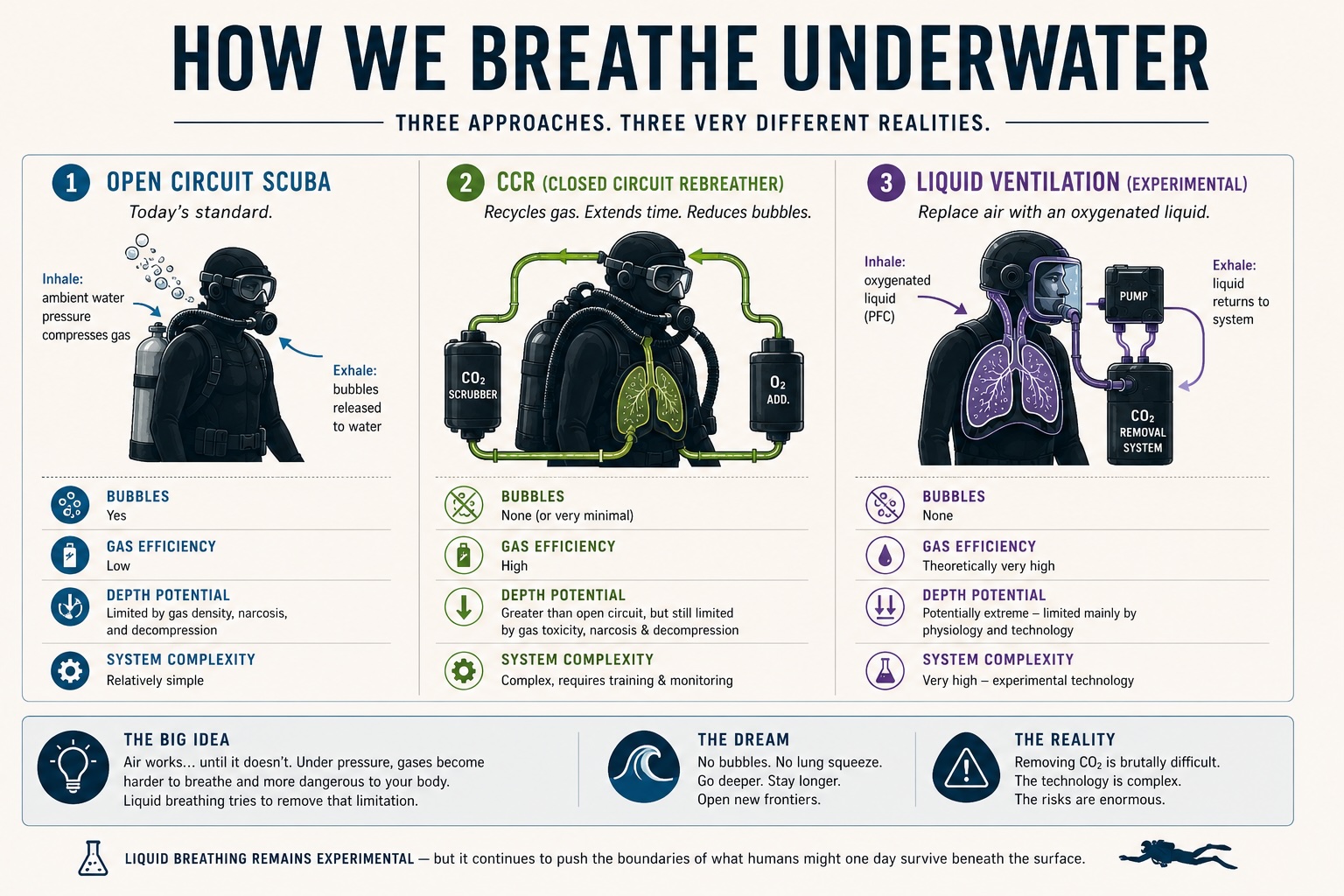
Most recreational divers use open circuit scuba.
You inhale from a tank.
You exhale bubbles.
The system is relatively simple, reliable, and understandable. It wastes a lot of gas, but for recreational diving, that tradeoff is usually acceptable.
Closed circuit rebreathers, or CCRs, are different. They recycle breathing gas, scrub out carbon dioxide, and maintain a selected oxygen level. They are far more efficient than open circuit scuba and can be powerful tools for technical diving, photography, cave diving, wreck diving, and long-duration dives.
But a CCR still uses gas.
Liquid breathing is a different animal entirely.
It is not just a more efficient scuba system.
It is an attempt to change the breathing medium itself.
Open circuit asks:
How do we bring enough gas?
A CCR asks:
How do we reuse and manage the gas more efficiently?
Liquid breathing asks:
What if gas-filled lungs are the thing we need to get away from?
That is a much bigger leap.
And bigger leaps usually bring bigger problems.
The Real Monster Under Pressure: Carbon Dioxide Retention
Most people assume the hard part is oxygen.
Can the liquid carry enough oxygen?
Can the lungs absorb it?
Can we keep the diver alive?
Those are important questions.
But the real villain is carbon dioxide.
Divers should respect CO2.
A lot.
CO2 buildup can make you feel air-starved, panicky, confused, and desperate. It can turn a manageable situation into a nightmare. It can make calm people feel like they need to bolt for the surface.
With normal breathing, your lungs move gas in and out efficiently. Gas is light. It flows easily. Your respiratory system is built for it.
Perfluorocarbon liquid is not gas.
It is denser.
It is more viscous.
Moving it in and out of the lungs fast enough to remove CO2 is hard.
This is one of the major reasons liquid breathing has not become a practical diving technology.
Oxygen gets the attention.
CO2 ruins the party.
Negotiating with Physics: Nitrogen Narcosis, Vocal Speech, and the Sound of Silence
This is where things get speculative, and we need to be careful.
Liquid breathing does not magically erase pressure physiology.
Your body is still under pressure.
Your tissues are still exposed to dissolved gases depending on what is carried in the liquid and how the system is managed.
If inert gases are involved, narcosis and decompression questions do not simply vanish.
If oxygen levels are too high at pressure, oxygen toxicity becomes a concern.
If the liquid breathing system is designed around different gas mixtures or oxygen partial pressures, then the whole dive profile becomes a specialized medical and engineering problem.
In other words, liquid breathing is not a cheat code.
It is not “turn off decompression sickness.”
It is not “become immune to narcosis.”
It is more like opening a door into an entirely different set of problems.
Some of those problems might be solvable.
Some might not.
In other words, liquid breathing is not a way to escape physics. It is simply another attempt to negotiate with it.
If liquid breathing ever became practical, I do not think it would show up first as a recreational scuba product.
Nobody is going to be on a Caribbean dive boat saying, “Welcome aboard, folks. Tanks are on the left, weights are under the bench, and if anyone paid for the premium package, Steve will be filling your lungs with oxygenated goo after the briefing.”
No.
If this technology ever became useful, it would almost certainly appear in extreme and specialized settings first.
Submarine rescue.
Military operations.
Deep scientific exploration.
High-pressure medical treatment.
Ultra-deep industrial work.
Maybe some future version of saturation diving or deep habitat support.
And even then, it would probably require a massive support system.
This would not be a backpack and a buddy check.
This would be a platform.
A team.
A procedure.
A checklist thick enough to stun a dolphin.
It might be diving, but it would not feel like the diving most of us know.
One genuinely interesting side effect of liquid breathing is the possibility of reducing or eliminating bubbles.
For open circuit divers, bubbles are part of the experience.
They are loud.
They are obvious.
They disturb the water.
They announce your presence to every fish, turtle, photographer, and submarine captain in the area.
CCRs already reduce that dramatically, which is one reason photographers and certain technical divers love them.
But a truly liquid-based system could theoretically be even stranger.
No normal exhalation plume.
No roaring bubble trail.
No familiar inhale-exhale rhythm.
Just a diver moving through the water in a deeply unnatural silence.
From a military or wildlife-observation standpoint, that is fascinating.
From a human standpoint, it is also creepy as hell.
One of the things I love about scuba is the rhythm of breathing. It becomes part of the dive. It calms you down. It gives the experience a pulse.
Take that away and I am not sure what is left.
Exploration, yes.
Science, yes.
But maybe less of the meditative magic that makes diving feel like diving.
Here is another weird little problem.
How would you talk?
Human speech depends on air moving across vocal cords.
If your lungs are filled with liquid and your breathing is being managed by some elaborate system, normal speech is probably not happening in the usual way.
That means communication would need to be electronic, gestural, text-based, neural, or something else entirely.
Again, not impossible.
But it is another reminder that changing the breathing medium changes everything.
Scuba is already equipment-intensive.
Liquid breathing would be life support in the most literal, least casual sense.
Why We Keep Trying to Negotiate with Physics: The Human Component
Scientifically?
I am fascinated.
As a diver?
I want to know everything about it.
As a guy with lungs?
Absolutely not.
At least not casually.
This is one of those technologies where I can respect the science, admire the engineering, appreciate the courage of the researchers, and still say, with my whole chest:
No thank you.
I love diving.
I love the ocean.
I love weird underwater technology.
But I am not in a rush to experience the sensation of drowning correctly.
Liquid breathing may never become practical for divers.
It may remain mostly a medical research topic, a military-adjacent curiosity, and one of the most unsettling ideas ever smuggled into a mainstream science fiction movie.
But the fact that humans seriously explored it says something important about us.
The deep ocean is one of the most hostile environments on Earth.
It crushes us.
It chills us.
It complicates our chemistry.
It punishes sloppy thinking.
It turns breathing into an engineering project.
And when faced with all of that, some human being looked at the problem and said:
Okay, but what if we filled the lungs with liquid?
That is ridiculous.
That is brilliant.
That is horrifying.
That is very, very human.
We are not fish.
We are not built for the deep ocean.
But we keep trying to visit anyway.
And honestly, I kind of love that about us.
If you have not watched The Abyss in a while, it absolutely deserves a rewatch.
Before I was a diver, a lot of it sounded like sci-fi technobabble.
After becoming a diver, I realized something much cooler:
A surprising amount of it was grounded in real underwater science.
And James, if by some miracle you are reading this, let’s go diving sometime.
We can spend the week arguing about liquid breathing over pitchers of Monkey Lalas in Roatán.
Or we can go somewhere in Asia and find the local equivalent.
I am flexible.
Important note: This article is a diver-friendly exploration of liquid breathing concepts, not dive training, medical advice, or technical diving guidance. Do not attempt experimental breathing systems, extreme depth diving, or anything remotely like this without proper professional training, equipment, support, and medical oversight.