The Day Archimedes Finally Made Sense Underwater 🌊

The Two Invisible Forces Fighting Over Every Diver Underwater
Most divers memorize buoyancy rules. Everything changed for me when I finally understood the core physics fighting over every profile.
Scuba instructors love asking buoyancy questions.
You know the ones.
“You are neutrally buoyant in fresh water. You jump into salt water. Do you sink or float?”
And every single time somebody asked me those questions during my own scuba training, my brain would lock up for a few seconds while I mentally tried to sort through the answer.
Not because the question was hard.
Because I was trying to memorize outcomes instead of understanding what was actually happening underwater.
Then one day, somewhere along the line, Archimedes finally clicked for me.
Not the math.
Not the equation.
The principle itself.
And once it clicked, buoyancy stopped feeling mysterious.
It started feeling intuitive.
The Two Invisible Forces Acting On Every Diver
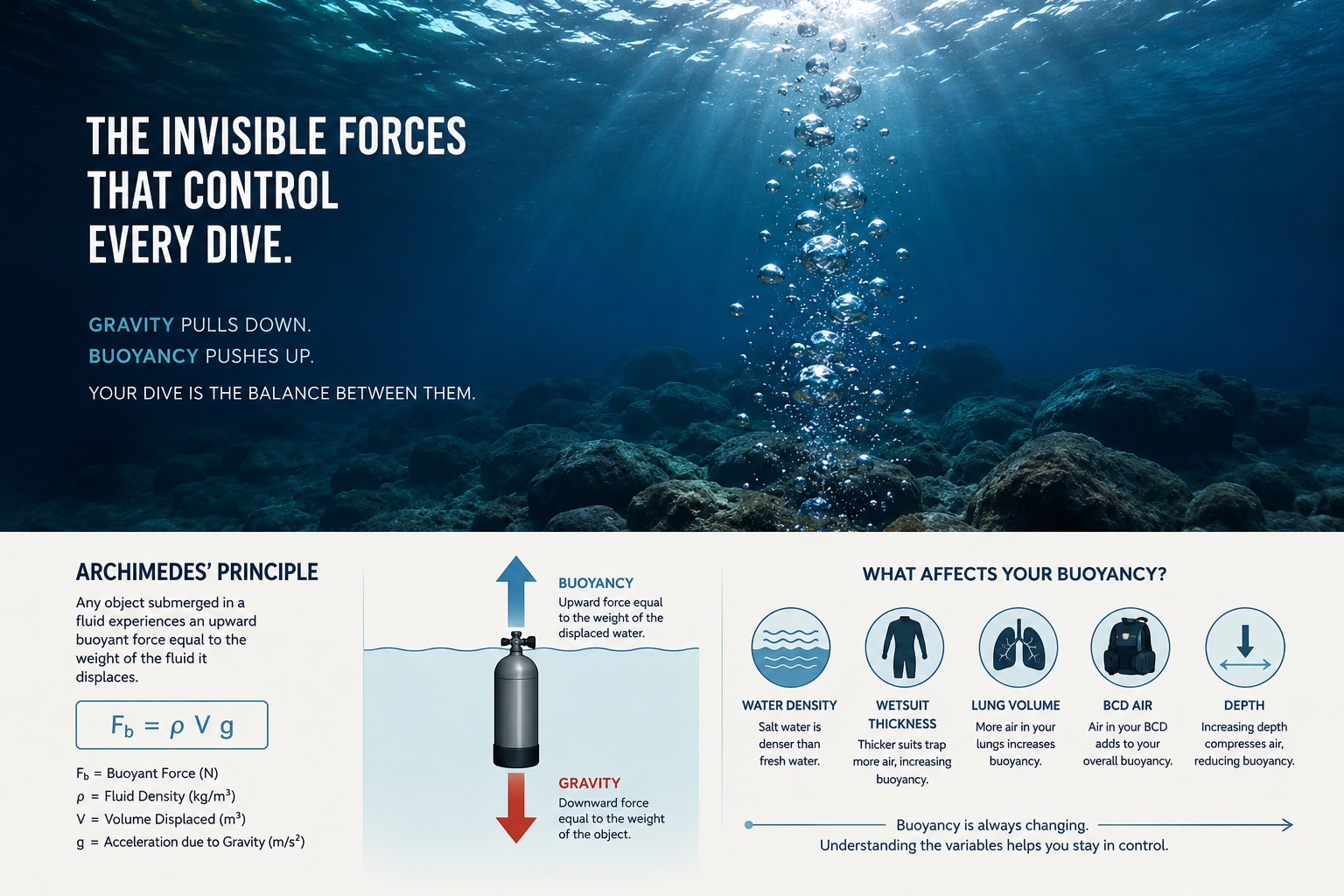
At its core, buoyancy underwater is really just two forces fighting over you constantly:
Gravity pulls you downward.
Buoyancy pushes you upward.
That’s it.
That’s the entire game.
The important realization for me was understanding that gravity does not really change underwater.
Your weight is your weight.
What changes is the buoyancy force acting against it.
And buoyancy changes based on how much water you displace and how heavy that displaced water happens to be.
That suddenly made the fresh water vs salt water question incredibly easy.
Salt water weighs more than fresh water.
If the water you displace weighs more, the upward buoyancy force increases.
So if you were perfectly neutral in fresh water and suddenly moved into salt water?
You would become more buoyant.
You would float more.
Suddenly the answer was not something to memorize.
It was something you could reason through.
That was a huge shift for me.
The Dynamic Buoyancy Variables Divers Actually Feel
This is where the theory starts becoming practical.
Several things can affect your buoyancy underwater:
- Salt water vs fresh water
- Wetsuit thickness
- Body composition
- Lung volume
- Equipment configuration
- Depth changes
Some of these changes are subtle.
Some are dramatic.
A thick wetsuit, for example, contains countless tiny gas bubbles inside the neoprene. Near the surface those bubbles are larger and more buoyant. As you descend, pressure compresses them, reducing their buoyancy.
The exact same thing happens to any air trapped inside your BCD.
That means buoyancy is never truly static underwater.
It is constantly changing as you move through the water column.
Which is why good buoyancy control is not really about “setting it once.”
It is about learning to constantly make small intelligent adjustments.
Your Lungs Are a Precision Buoyancy Fine-Tuning Device
This is one of the biggest “cheat codes” I teach students.
Your BCD is not the only buoyancy tool you have underwater.
Your lungs matter enormously too.
I’m a big guy with a barrel chest and large lungs, so I feel this effect very strongly on almost every dive.
The depth of my inhale matters.
The speed of my breathing matters.
The timing of my inhale and exhale matters.
A deep breath can noticeably increase my buoyancy.
A full exhale can noticeably decrease it.
And when I am trying to maintain a precise position in the water column, those tiny changes matter a lot.
I teach students to think of their buoyancy systems in two categories:
Your BCD handles gross adjustments.
It gets you “in the ballpark.”
Your breathing handles fine adjustments.
Once you are close to neutral, your lungs become an incredibly precise trimming tool.
That realization changes everything for many divers.
Suddenly buoyancy stops feeling random.
It starts feeling controllable.
Why Your BCD Is an Underwater Braking System, Not an Elevator Button
Nothing transforms me from Fun DWF into Grumpy DWF faster than watching somebody mash their inflator button like they are calling an elevator.
Your BCD is not supposed to launch you upward and downward through the water column.
I teach students to think of their BCD as a braking system.
That mental model changes everything.
At the Surface
When divers surface after a dive, I will often immediately tell them:
“Put air in your BCD.”
Why?
Because you should not have to constantly kick just to remain comfortably afloat at the surface.
Inflating your BCD acts like setting the parking brake on a car.
It keeps you comfortably supported at the surface until you are ready to move, swim, or exit the water.
During Descent
As you descend, the air inside your BCD and wetsuit compresses.
That means your buoyancy naturally decreases as depth increases.
If you are descending too quickly, a very small burst of air into your BCD acts like braking pressure.
Not a giant correction.
Not an emergency inflation.
Just enough to slow and stabilize your descent.
During Ascent
The opposite happens on ascent.
As pressure decreases, the remaining air inside your BCD expands.
Your buoyancy increases automatically.
Many divers first really notice this somewhere between roughly 60 and 30 feet.
Suddenly it feels like the BCD is trying to run away with them toward the surface.
That is your cue to release small amounts of air and stay ahead of the expansion.
Again:
Not dumping all your air.
Not panic-deflating.
Just small controlled adjustments to keep yourself in the ballpark.
Buoyancy Calibration: Why Small Adjustments Beat Big Corrections
This is another lesson many divers eventually learn the hard way.
Huge buoyancy corrections usually create huge buoyancy problems.
Most of the time, divers only need very tiny BCD adjustments.
Often:
- quarter-second bursts
- maybe half-second bursts at most
Then comes the important part:
Wait.
After every adjustment, you need to complete a full breathing cycle before deciding whether another correction is needed.
That means:
- fully inhale
- fully exhale
Why?
Because your inhale represents your maximum buoyancy.
Your exhale represents your minimum buoyancy.
You need to understand both before deciding whether you are actually properly balanced.
A lot of divers chase buoyancy problems they accidentally created themselves by adjusting too aggressively and too quickly.
The Closed Circuit Rebreather (CCR) Loop Volume Caveat
One important caveat here:
Using breathing as a buoyancy fine-tuning tool works wonderfully in open circuit scuba because your lung volume constantly changes throughout the breathing cycle.
Closed Circuit Rebreather diving changes that relationship significantly.
CCR divers often work much harder to maintain a stable loop volume, meaning some of these “breathing cheat codes” do not translate the same way.
In other words:
If you eventually move into CCR diving, you may discover you need to relearn parts of buoyancy control all over again.
That is part of what makes diving so interesting.
There is always another layer to learn.
What fascinates me now is that Archimedes figured this out over 2,000 years ago.
And yet every single diver still experiences those exact same forces on every dive today.
Not academically.
Physically.
You feel it every time:
- you hover motionless
- you inhale deeply
- your wetsuit compresses
- you switch from fresh water to salt water
- you fight your buoyancy
- or finally stop fighting it
At some point, buoyancy stops feeling like magic.
And starts feeling like awareness.
That is usually the moment divers become dramatically more comfortable underwater.