Why the RDP Still Matters (Even In a World of Dive Computers)
Why the RDP Still Matters (Even in a World of Dive Computers)
Sharing the Depth: Mysterious Wrist Boxes, Lego Logic, and the Danger of Skipping the Model
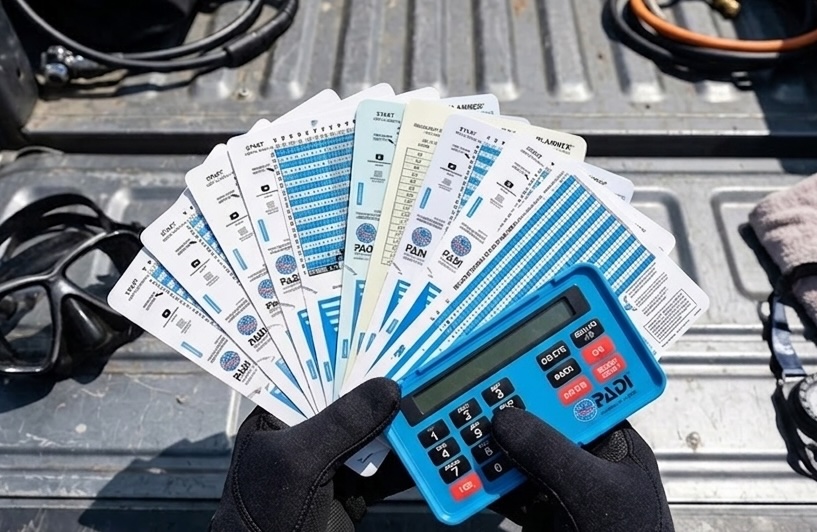
When I learned to dive “back in the ’10s,” mastering the manual tools, specifically the printed Recreational Dive Planner or that wonderfully clicky, high-pitched beeping electronic calculator known as the eRDP-ML, was a mandatory, non-negotiable rite of passage. If you couldn’t navigate the plastic rows or type your multi-level profiles into that little blue box to track your surface intervals, you simply didn’t get your C-card. It hasn’t been that way for a while now. Training standards eventually evolved to allow instructors to teach the entire Open Water course using dive computers from day one. There was no scarlet letter or “Computer Only” limitation stamped on the resulting certification; a diver trained entirely on a digital screen got the exact same credential as someone who sweated over the paper grids. Today, whenever I encourage my own students to opt into the table portion of the curriculum, I inevitably hear the exact same counterargument: “But Frank, I’m just going to use a dive computer anyway.”
To be entirely fair, the market has changed drastically since my early days in the sport. Dive computer prices have come way down, and owning one is no longer the heavy financial lift it used to be. In fact, a significant number of my students now show up to day one of classroom training with a fully functioning dive computer already strapped to their wrist, usually made by a certain prominent fruit company. Whether a student sits down to learn the tables or bypasses them completely, I am certain they will be using a smartwatch or a dedicated console on every single real-world dive they take for the rest of their lives. Modern dive computers are exceptional pieces of life-support technology. I use one every time I submerge, and frankly, if you are diving much deeper than sixty feet, it is simply bad judgment not to have one on your wrist.
But opting out of the tables means you are choosing to skip the actual model-building step of your education. You are jumping straight to a digital screen’s final output without ever seeing or understanding the mechanical engine running underneath it. That conceptual gap is exactly why I still choose to teach the RDP. The point isn’t to look retro or to force people to carry a plastic grid on a dive boat; the point is that the table remains the absolute clearest way to turn abstract nitrogen loading into a physical, visible system that you can watch change in real time.
A dive computer is great, but it completely hides the underlying engine. A dive computer is not a Star Trek tricorder. It does not scan your body, it does not measure nitrogen directly, and it has no idea how hard you are working, whether you are freezing, or if you are completely overexerting yourself. It simply comes along for the ride, tracking depth and time to run a mathematical model based on that specific profile. That model is built on assumptions about how nitrogen is absorbed and released by the human body over time. This is exactly why we never share dive computers between divers. Even tiny changes in depth or timing meaningfully change the modeled nitrogen loading because the entire calculation is based on your specific, continuous exposure history. Two buddies can look like they did the identical dive, but their computers are not telling the same story.
The Origin Story: From Navy Iron Men to DSAT
Before dive computers took over the boat decks, recreational diving relied entirely on printed decompression tables. The catch was that those early systems were borrowed directly from the military, specifically the United States Navy dive tables. Navy tables were designed for a very specific type of diver, typically an exceptionally fit, young, male sailor performing grueling, single-purpose underwater tasks. Furthermore, the military model assumed a square-wave profile, meaning the diver dropped straight down to a deep depth, did their work, and came straight back up, rarely doing multiple repetitive recreational-style profiles day after day. Applying military-style square-profile tables to a casual vacation diver doing multiple shallow reef dives a day created a poor fit. The system was safe, but often clunky, restrictive, and not especially well matched to the way recreational divers actually spend their time underwater.
That massive operational gap is exactly why Diving Science and Technology, or DSAT, stepped in during the late 1980s to completely re-engineer the system. They conducted extensive Doppler ultrasound research to track silent microbubbles in actual recreational divers, building an entirely new mathematical model from scratch. The result was the Recreational Dive Planner. It was explicitly tailored for multi-level, repetitive recreational profiles. It was not designed to be sophisticated or academic, but rather to be highly usable on a rocking boat. By shortening required surface intervals and maximizing time in typical recreational depth ranges, it quietly introduced the single most important concept in modern diving: nitrogen exposure does not reset when you surface. It carries forward, and that same basic idea is still doing more heavy lifting inside your modern dive computer than most divers ever realize.
Where the RDP Earns Its Place
The true value of working the table manually is that it forces you to realize your dives are connected events rather than isolated ones. When you calculate a repetitive profile on paper, you physically cannot advance to the next step without factoring in your surface interval credit and carrying your residual nitrogen forward. Something shifts in a student’s brain during this process. Dives stop feeling like separate, disconnected entries in a logbook and start becoming a continuous, rolling system of exposure. That exact ongoing connection is what your dive computer is constantly calculating in the background, but the table actually makes it visible.
This is also where I see the biggest friction. I have had students, particularly school teachers who get incredibly anxious about this part, who get stressed out at the idea of a “math test.” The moment they hear the acronym RDP, they hear numbers, and they immediately assume complexity. But the RDP is not math in the way people fear math. It is much more like building with Lego. You can build incredibly complex structures with Lego, but at the core, it is just simple pieces used in different combinations. The RDP is just a few simple rules, a few repeated steps, and the same logic applied consistently. If you get stuck, the answer is usually right in front of you because the instructions are literally printed right on the plastic. The goal is pattern recognition, not memorization. Once you see the pattern, the system stops feeling like math and starts feeling like pure logic.
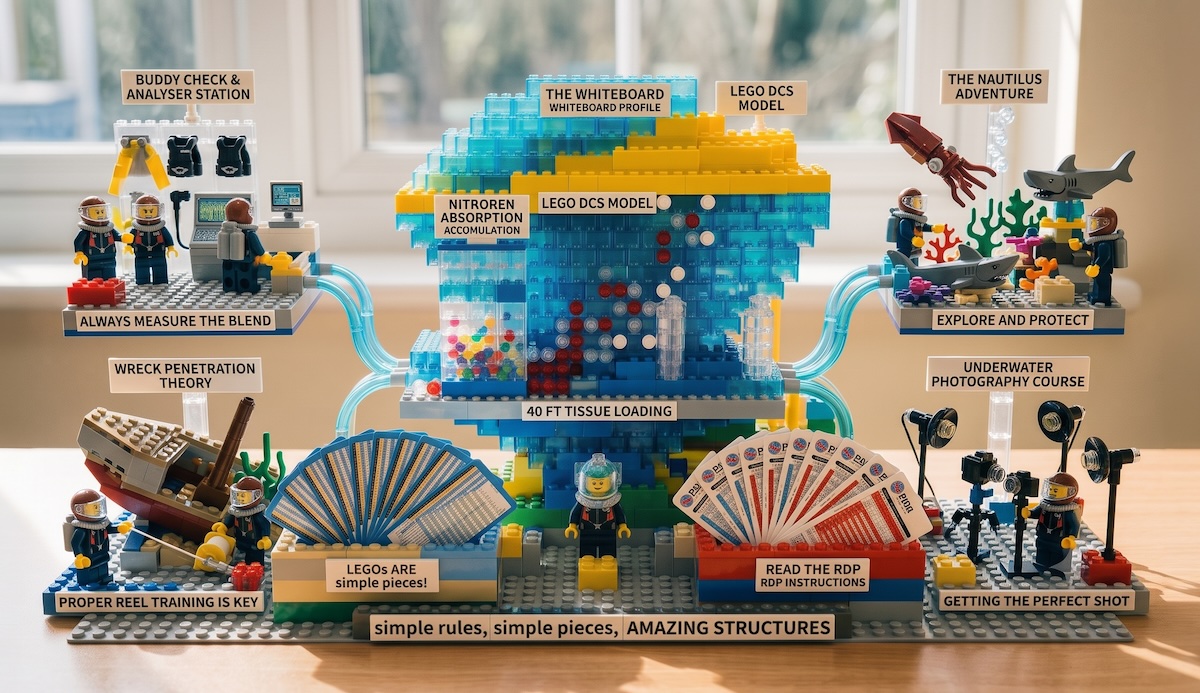
The DWF Lego logic model. It turns out tracking multi-profile tissue loading is exactly like building with bricks: complex structures built entirely out of incredibly simple pieces.
My Own “Aha” Moment and the Student Reality
I did not always appreciate this tool. I originally learned the RDP like most instructors do, treating it simply as a mandatory part of the process. Sometime in the spring of 2010, between Open Water classes, I sat down for a couple of hours and actually worked through it deliberately. I didn’t do it to pass an exam, but purely to understand the mechanism. That is when it finally clicked, not just how to use it, but exactly what it meant. That understanding has stayed with me for over 16 years, and I have found it is unfortunately not the norm. Most divers never get that moment unless someone slows them down long enough to see the pattern.
When students skip the RDP, creating that major conceptual gap, it shows up later on the boat decks. They can read the numbers on their screen, but they do not actually understand what changed between dive one and dive two. That is not a technology problem, it is a conceptual one. Once that structural baseline is there, everything else becomes easier to interpret, including why computers adjust conservatism on repetitive profiles, why depth changes matter so much, and why a quick second dive is never as disconnected as it feels.
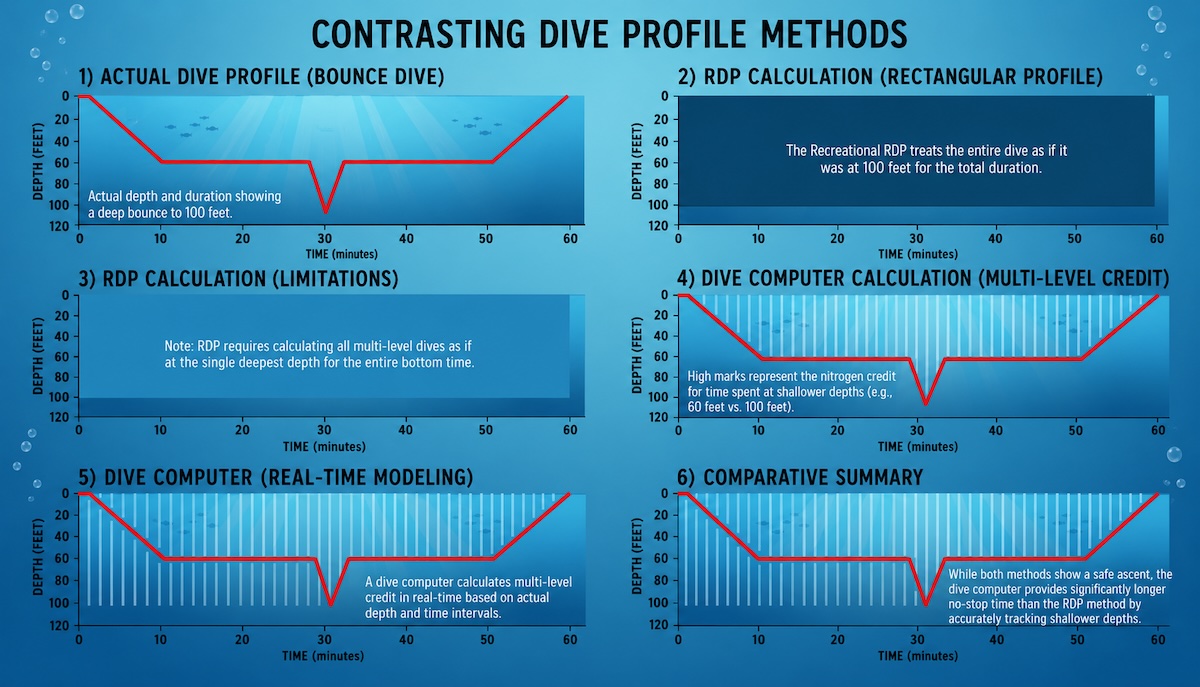
The calculation engine breakdown. Traditional tables assume you spent your entire dive at the deepest point (the square wave), while a modern computer tracks your actual depth every single second.
The DWF Training Lab: Getting Your Reps In
Most students do not need more lectures to understand the table; they just need more reps. But standard workbooks run out of problems quickly, leaving students memorizing random answer sheets instead of actually learning the table-reading habit.
That exact educational bottleneck is why I built the free Dive With Frank Dive Table Trainer. Think of it like an unlimited digital workbook. It doesn’t contain the tables themselves or replace the blue plastic card from your PADI crewpack, but it automatically generates thousands of randomized practice scenarios.
Built explicitly to bridge the gap from the classroom to mastery, the trainer features:
- Endless Variety: Generates thousands of randomized scenarios covering pressure groups, surface intervals, residual nitrogen time, minimum surface intervals, and maximum bottom times.
- Scales With Your Confidence: Choose your difficulty, ranging from a beginner-friendly “Easy Mode” up to an “Advanced Tier” that throws complex decompression-limit scenarios at you.
- Instant, Step-by-Step Logic: Don’t just get a right/wrong answer. Every single checked problem provides a full breakdown explaining exactly which row to round up to, what rules apply, and how the final code was reached.
- Shareable Problem Codes: Every scenario generates a unique code. Copy and pass it to your buddy or instructor so they can pull up the exact same randomized problem to track down where your logic went sideways.
Ready to build confidence before your next class, checkout dive, or instructor session? Give yourself unlimited reps with the free Dive With Frank Dive Table Trainer.
No answer key memorization. No running out of practice problems. Just table logic until it finally clicks.
The Bottom Line
You do not need to use plastic tables on a dive boat to dive safely. But if you take the time to understand them during your training, your dive computer stops being a mysterious box that simply dictates your limits. It becomes what it actually is: a real-time calculator running a dynamic model of your personal exposure history. Once you see that, you stop blindly trusting the screen and you start understanding the system. That is the true goal of dive education. It isn’t about memorizing historical rows or forcing yourself to love math; it’s about building the analytical baseline required to navigate the underwater world with complete confidence. Grab your table, get your reps in, and keep diving.