What Am I Hoping to Find When I Get There?
Depth is not bad. Depth is not good. Depth is expensive. Spend it wisely.
Nearly every scuba diver has been asked the same question.
“How deep have you gone?”
Non-divers love that question.
Honestly, I get it.
Depth is easy to understand. It sounds impressive. It gives people a number they can wrap their heads around. If someone says they dove to 100 feet, that sounds more impressive than 40 feet. If someone says they went to 130 feet, that sounds even better.
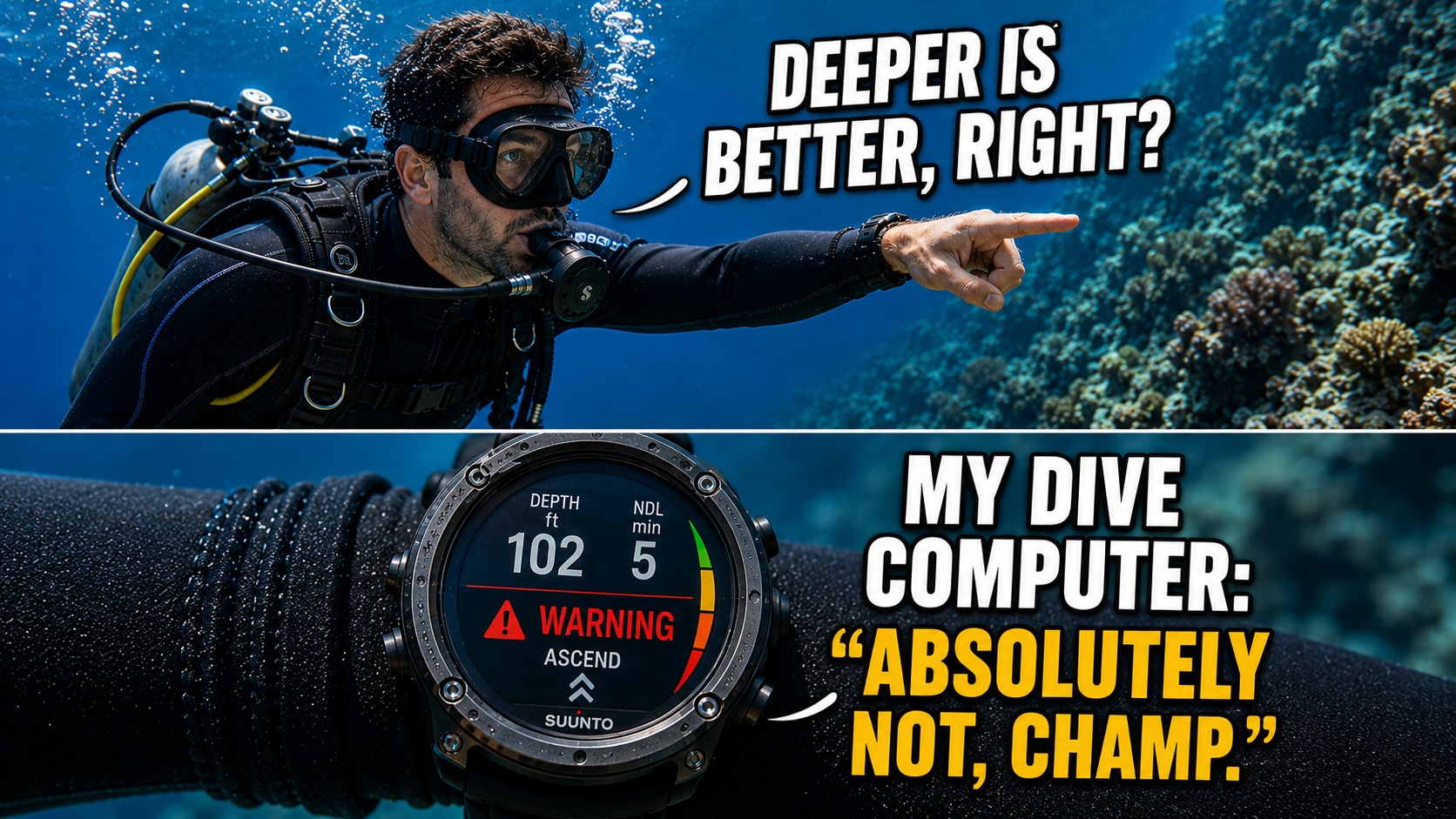
Because deeper is better, right?
Right?
Well.
Maybe.
When you are new to diving, depth can feel like a scorecard. You start at 40 feet. Then 60. Then maybe you take Advanced Open Water and do your deep dive. Suddenly 100 feet feels like a milestone. Then 130 feet starts sounding like the grown-up table.
I understand that instinct because I had it too.
Going deeper is a natural way to push yourself, especially when you are newer and do not yet have a huge library of diving experiences. You may not know how to evaluate buoyancy, trim, gas planning, situational awareness, marine behavior, or decision making yet.
But you understand numbers.
And depth gives you a number.
The problem is that after you have been diving long enough, the question starts to change.
At first, the question is:
How deep can I go?
Then it becomes:
What is the deepest I have been?
Eventually, if you are paying attention, it becomes:
Why am I going there?
And after enough dives, the question becomes even more useful:
Will going deeper actually make this dive better?
My Honest Answer to the Deep Scuba Question
When people ask me how deep I have been, I usually tell them.
About 138 feet.
Then I immediately explain why that number is not a flex.
The extra eight feet happened because I screwed up.
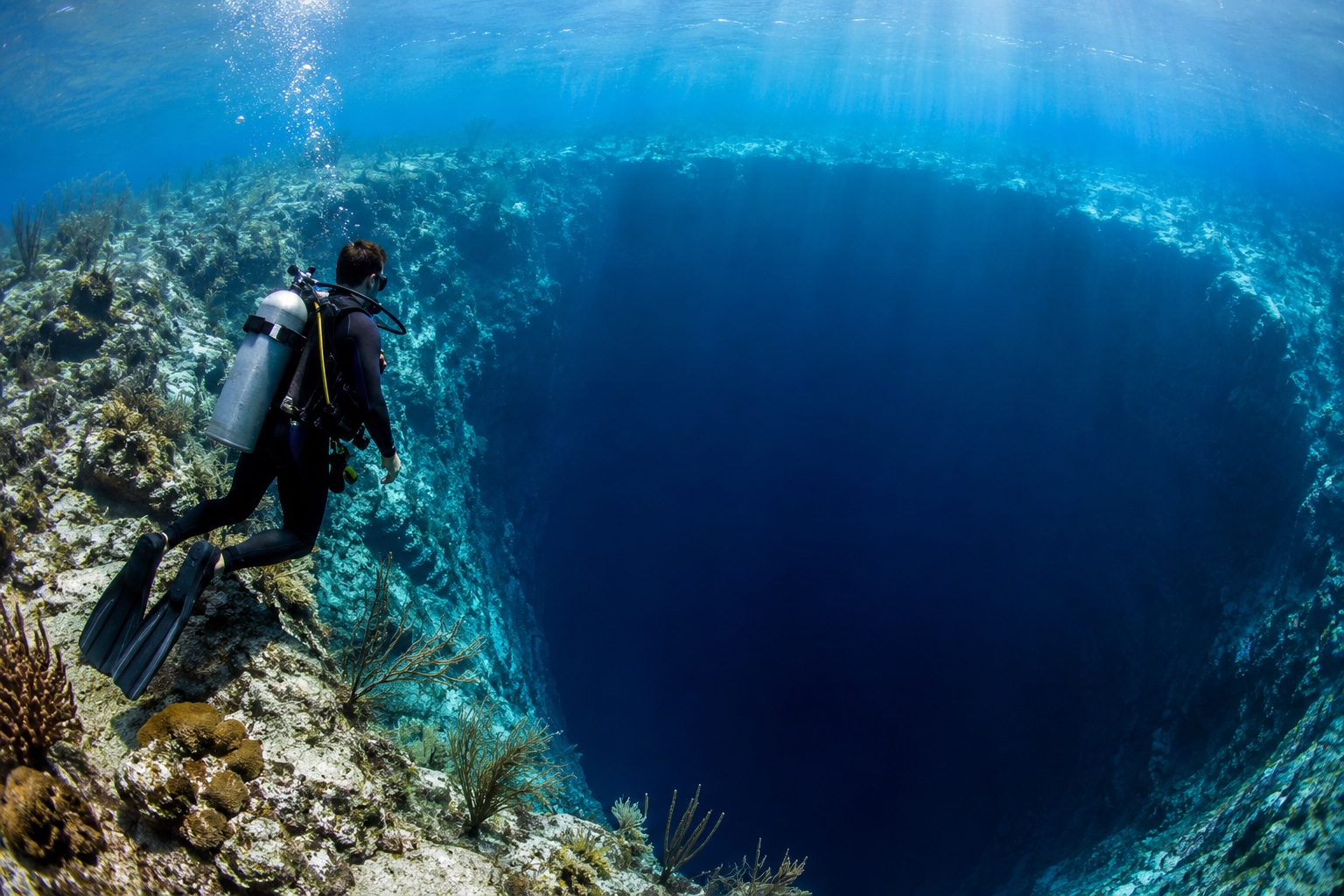
It was during a blue hole dive in the Exhumas in the Bahamas. I was descending faster than I expected. I was not paying as close attention as I should have been. I was not an instructor at the time. I was not leading a trip. I was just on vacation, near the side of the hole, enjoying the dive.
And honestly, I get a little freaked out just floating in the center of a blue hole.
There is something about that open blue void that gets my attention. I like having a reference. A wall. A reef. Something that tells my brain where I am in the world.
So there I was, near the side of the hole, descending a little faster than I realized, and suddenly I had collected an “impressive” number that I had not meant to collect.
That is not an achievement.
That is a lesson.
I was lucky my computer did not get angry and lock me out. I corrected it, continued the dive, and filed the experience away in the mental folder labeled:
Pay better attention, dummy.
That is part of why I do not treat depth as a bragging point.
My deepest dive should not be dramatically beyond my training. It should not be a trophy I stole from bad judgment. I have limits I am trained and certified to follow. My number should be at that limit at most.
If someone’s deepest dive is wildly beyond their training, that is not automatically evidence of skill.
It may simply be evidence that they exceeded their training.
That is a very different thing.
My own depth history was not especially wild.
I did it by the book.
I took Advanced Open Water. During my deep dive, I went down to about 100 feet. Later, I took a dedicated deep diving class at Casino Point off Catalina Island.
Casino Point is a great place for that kind of training because there is actual depth available, and there is even a little plaque honoring Jacques Cousteau down around 130 feet.
During that class, we did the classic deep-diving exercises.
We did math problems at the surface.
We signed our names.
Then we went down to depth and did them again.
I saw the difference.
I felt the difference.
I looked at colorful slates at depth with a flashlight and without a flashlight, and I saw how quickly color gets swallowed when light disappears.
That kind of training matters because it does not just tell you that depth changes things.
It shows you.
Thankfully, I have never felt fully narc’d underwater.
Knock on wood.
But I have felt the edges of it. I have felt that little uptick in anxiety at depth, especially when I have students with me. Maybe that is narcosis. Maybe that is task loading. Maybe that is just the DWF papa bear instinct kicking in.
Whatever it is, I pay attention to it.
That is one reason I wanted a professional with me the first time I hit those depths.
Not because I was afraid.
Because I respected what I was doing.
The Grand Cayman Lesson: The Cost of Nitrogen Loading
The first time I went to Grand Cayman, I spent my first day diving on air and generally diving deeper than I was used to.
Not recklessly deep.
Just deep enough to matter.
I was glued to the bottom much of the morning because that is where the reef was and that is where the action seemed to be. Then, during what I think was my second dive of the day, my dive computer suddenly gave me the underwater equivalent of:
“Hey dummy. You are almost out of NDL time.”
Of course, it was not sudden.
I had spent the morning loading nitrogen. I had been diving on air. I had been deeper than necessary for longer than necessary. My computer was not surprising me. It was simply giving me the bill.
So I spent a good chunk of that dive hovering around 30 to 40 feet because I had basically squandered my no-decompression time for the day.
That was one of my early lightbulb moments.
Diving deep is fine.
Diving deep with a reason is great.
But diving deep just because you can?
That can quietly steal the rest of your dive.
This is the part newer divers do not always appreciate.
Depth is not free.
At depth, your gas disappears faster. Your no-decompression time disappears faster. Your flexibility disappears faster. Your margin for error gets smaller. Your surface intervals may matter more. Your options later in the day may become more limited.
And yes, narcosis is real.
Just because you have never felt narc’d does not mean it cannot happen on your very next dive. Conditions change. Stress changes. Workload changes. Fatigue changes. Depth does not care how confident you felt yesterday.
This is not meant to scare anyone.
It is meant to encourage purpose.
Act with intent.
Plan the dive you are actually doing.
Do not just wing it because the number sounds cool.
Every foot deeper should buy you something.
If it does not, why are you there?
Why Most of the Best Scuba Sights Are Above Recreational Limits
Here is the funny thing.
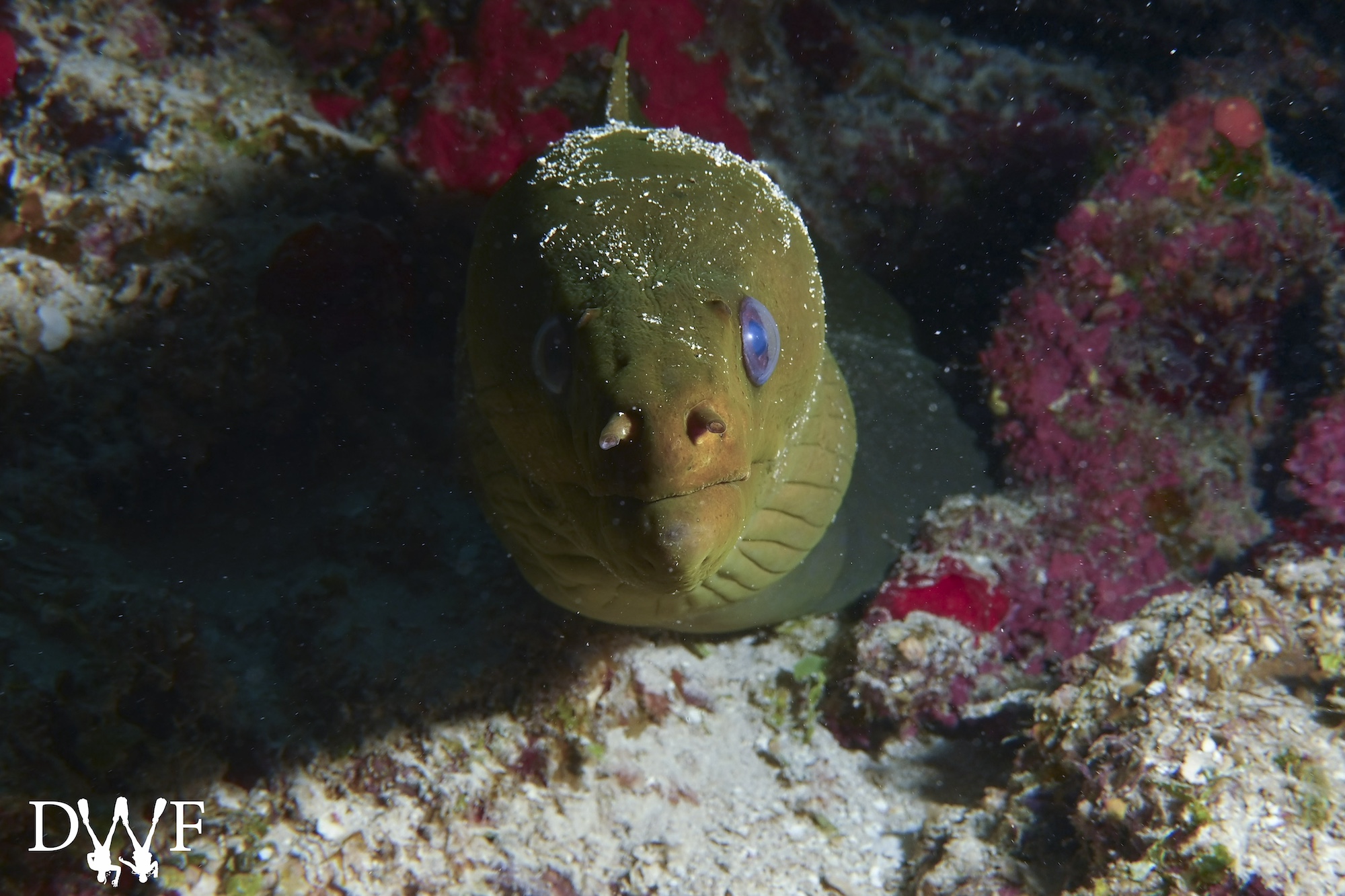
Most of the most amazing things I have ever seen underwater have been between about 20 and 80 feet.
That is not deep.
That is reef territory.
That is sunlight territory.
That is where coral can thrive because light still reaches it. More thriving coral means more fish. More fish means more activity. More activity means more of the underwater chaos and beauty most of us actually want to see.
Turtles.
Reef sharks.
Mantas.
Macro life.
Color.
Movement.
Fish doing fish things.
There is a reason some of the most memorable dives in the world happen well above recreational limits. Coral reefs, kelp forests, seagrass beds, manta cleaning stations, shore dives with friends, muck dives, macro dives, and shallow reefs can all be spectacular.
The ocean does not save all the good stuff for 130 feet.
Sometimes the best dive of your life happens shallow enough that your computer is bored.
Now, to be clear, there is some really cool stuff at depth.
I am not anti-depth.
I am not anti-technical diving.
I am not opposed to going deep.
Some places are worth it.
In the Philippines, I dropped down to around 130 feet to get a shot of a massive fishball. If you have never seen one, imagine thousands of fish packed so tightly together that they look less like individual animals and more like a living storm.
The school twists.
Turns.
Contracts.
Expands.
It looks like weather with fins.
That was worth it.
But I also knew what I was buying.
I knew that brief drop was going to shorten my dive. I knew my gas would go faster. I knew my nitrogen loading would increase. I knew I was spending part of my dive budget for that image.
And that is the difference.
I was not bouncing down there so my computer could record a number.
I was going there because there was something worth seeing.
Personal Risk vs. Shared Risk: Exceeding Recreational Boundaries
Years later, on an entirely different trip, I saw a different lesson play out.
This was also on a liveaboard, but it was not the same dive where I accidentally hit 138 feet.
Another diver came back to the boat proudly showing his computer, which displayed something around 185 feet.
My first reaction was simple:
Why would you do that?
At first, I thought my objection was about risk.
And yes, there was risk.
But the more I thought about it, the more I realized that the deeper issue was not just personal risk.
It was shared risk.
On a liveaboard, your decisions affect everyone.
If you get bent, the boat may have to divert. Diving may stop. Emergency resources may be consumed. Other guests may lose dives they paid for. Crew members may have to manage a serious incident. The whole operation can be affected because one person wanted to see a bigger number on a screen.
That is the part that stuck with me.
The lesson was not simply:
That diver was reckless.
The lesson was:
That diver’s choices affected everyone around him.
There is a difference between accepting personal risk and exporting consequences to everyone else.
I have thought about technical diving plenty.
Believe me.
I have looked at CCR training. I have thought about deeper wrecks, longer dives, decompression procedures, and all the skills that come with that world.
And honestly?
It sounds awesome.
If I lived somewhere with 300-foot drop-offs outside my front door, I would probably be much more inclined to pursue something like CCR 100. If I regularly had access to deep walls, deep wrecks, or dives where blowing past recreational no-decompression limits made practical sense, I might feel very differently.
But I need my own use cases.
Not theoretical ones.
Not “someday maybe” ones.
Real ones.
Technical diving is not just another certification card. It requires training, practice, equipment, maintenance, procedures, gas planning, discipline, and continued proficiency.
The question is not whether I could do it.
The question is whether I would use it enough to stay sharp.
There are millions of active scuba divers worldwide, but that is still a tiny fraction of the population. Technical divers are a smaller slice of an already small slice.
From a teaching perspective, that math gets funny fast.
It is basically going from:
“Would you like to teach a few students?”
to:
“Would you like to teach a really few students?”
For some instructors, that is absolutely the right path.
For me, it has not become the right path yet.
Not because I dismiss it.
Not because I am afraid of it.
Not because I think it lacks value.
Because I have not yet found enough personal use cases to justify the commitment.
Before I invest years learning how to stay down there, I want a better answer to a simple question:
What am I hoping to find when I get there?
Evaluating Depth as Social Currency vs. Real Competence
Divers can be funny creatures.
We sometimes use easy numbers as substitutes for harder qualities.
Depth.
Certifications.
Dive counts.
Expensive equipment.
Big cameras.
Those things are easy to measure.
Skill is harder.
Judgment is harder still.
A diver can have hundreds of dives and still be careless. A diver can own expensive gear and still have poor awareness. A diver can go deep and still make bad decisions.
Depth is not proof of competence.
It is just proof that you went down.
That does not mean depth is meaningless.
It means depth needs context.
Why were you there?
Were you trained for it?
Did you plan it?
Did it serve the dive?
Did it make the experience better?
Or were you just trying to collect a number?
The older I get, the less interested I am in going deep simply because I can.
If there is something worth seeing down there, great.
Let’s go.
If there is a wreck, a wall, a fishball, a photograph, a formation, or an experience that justifies the cost, I am interested.
But if the only goal is to bounce down, tap a number, and come back up so my dive computer knows I was there, I am a lot less impressed than I used to be.
Because that number is not free.
It costs gas.
It costs bottom time.
It costs no-decompression time.
It costs flexibility.
Sometimes it costs the rest of the dive.
And if things go badly, it can cost other people too.
So yes, depth can be amazing.
Depth can be useful.
Depth can open the door to places most divers will never see.
But depth is not the destination.
Depth is a tool.
And like any tool, it works best when you have a reason to use it.
These days, before I ask how deep I can go, I find myself asking something better:
What am I hoping to find when I get there?
If the answer is something extraordinary, I am in.
If not, I will happily spend an hour drifting over a reef at 60 feet, watching fish do fish things.
After all these years, I have discovered that some of the best parts of diving are not found at the bottom.
They are found in knowing when the bottom is not the point.