Should You Even Bother With Nitrox?
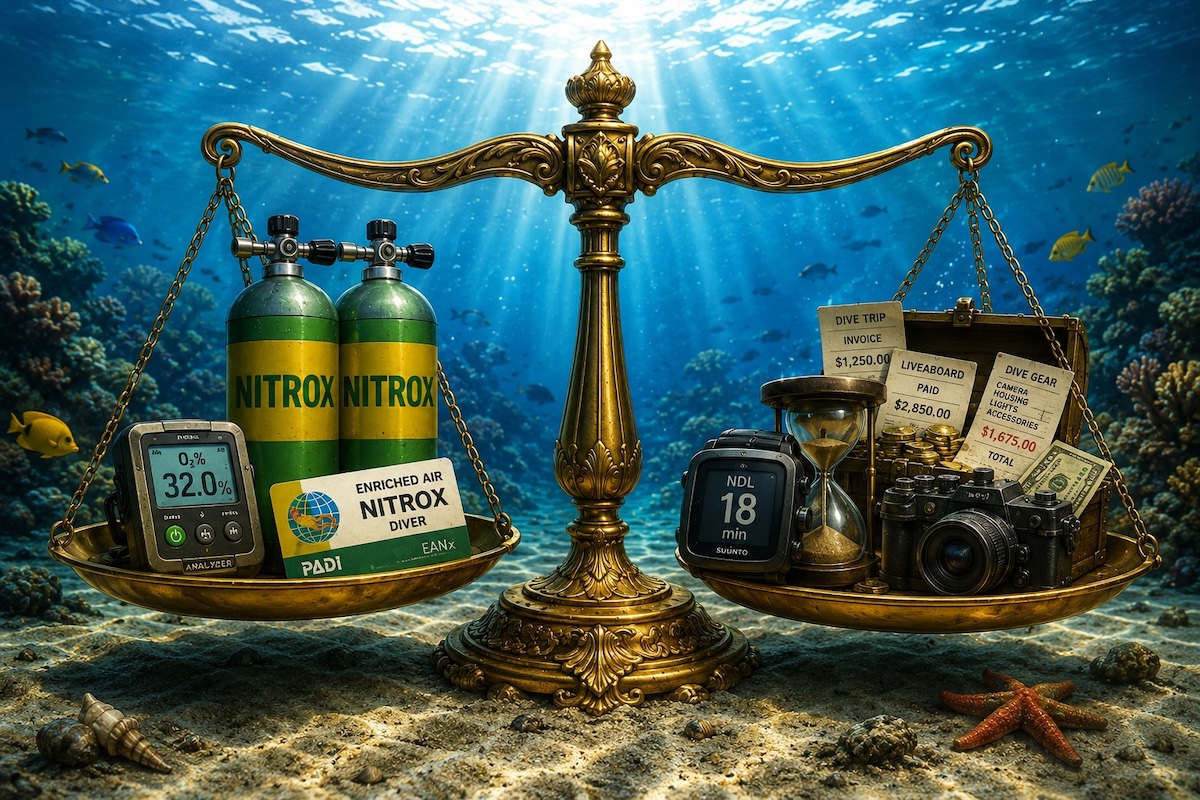
If you’ve been diving for more than about ten minutes, somebody has probably tried to convince you to get Nitrox certified. Sometimes it’s an instructor. Sometimes it’s the diver who just got certified last week and is suddenly acting like a gas-blending expert. Sometimes it’s the dive operator asking whether you want air or Nitrox while you’re standing on a boat trying to remember where you left your fins.
Eventually, most divers ask the same reasonable question: is Nitrox actually worth it?
My answer is probably not the one you’re expecting.
Sometimes no.
Sometimes absolutely.
The trick is understanding the difference.
I teach Nitrox, so yes, I have a horse in this race. If you take the course from me, I make a little money. If you don’t, I’ll somehow gather the strength to continue living. My integrity as an instructor is worth far more than whatever I might earn from one certification card, so I’m not interested in overselling what Nitrox can do.
Nitrox is a tool. Like any tool, it’s excellent for some jobs, unnecessary for others, and potentially dangerous if you don’t understand what you’re doing.
The 15-Second Answer
Nitrox contains less nitrogen than ordinary air. Because divers absorb nitrogen throughout a dive, reducing that exposure can provide longer no-decompression limits and more flexibility on repetitive dives.
For shallow dives, training dives, and many quarry dives, the difference may be negligible. For deeper recreational dives, multi-day dive trips, liveaboards, and repetitive diving, the benefits often become much more noticeable.
Nitrox is not necessary for every diver or every dive. It is simply another tool that can help manage nitrogen exposure when the dive profile calls for it.
Common Misconceptions About Nitrox
Before we go any further, let’s clear up a few things divers often hear about Nitrox.
Nitrox lets you dive deeper.
No. In many cases, Nitrox actually has a shallower maximum operating depth than ordinary air because of the higher oxygen content.
Nitrox makes decompression sickness impossible.
Absolutely not. Nitrox can reduce nitrogen exposure, but divers can still get decompression sickness if they exceed limits or make poor decisions.
Nitrox is only for advanced divers.
Not at all. Many newly certified divers earn their Nitrox certification shortly after Open Water because the concepts are straightforward and the certification is useful on many dive trips.
Nitrox gives you unlimited bottom time.
No gas mix eliminates limits. Nitrox can provide additional flexibility on certain dive profiles, but your dive computer still gets the final vote.
What Nitrox Actually Is
The air we normally breathe is roughly 78% nitrogen, 21% oxygen, and about 1% other gases. At the surface, most of us don’t spend much time thinking about that nitrogen because it is just along for the ride. Underwater, pressure changes the conversation.
As depth increases, pressure increases. That pressure causes more nitrogen to dissolve into your bloodstream and tissues. The deeper you go and the longer you stay, the more nitrogen your body absorbs. That is the entire reason no-decompression limits exist in the first place.
Nitrox attacks the problem from a fairly simple angle. Instead of breathing gas that is roughly 78% nitrogen, we replace some of that nitrogen with additional oxygen. Less nitrogen in every breath generally means less nitrogen entering your body during the dive.
That is the basic idea. You do not need a chemistry degree to understand it.
Why Divers Use Nitrox
For recreational divers, Nitrox usually matters for two practical reasons. It can extend no-decompression limits on certain dives, and it can reduce nitrogen loading during repetitive dives. Those benefits are measurable, predictable, and easy to see on a dive computer when the dive profile is deep enough or repetitive enough for nitrogen to become a limiting factor.
There is also the fatigue question, which is where divers start arguing on boats, message boards, and probably in the produce aisle if you get the right two people together. Many divers report feeling less tired after diving Nitrox, especially on multi-day dive trips. The science on that is not as clean as the math behind nitrogen loading, so I try to be careful with how I talk about it.
I cannot prove Nitrox makes me feel better after a long day of diving. I can tell you that I have had a couple of very clear experiences that changed how I choose gas on dive trips.
The First Time Nitrox Made Sense To Me
For the first few years after I became certified, Nitrox seemed useful in theory but unnecessary in practice. Most of my diving was shallow enough that no-decompression limits were not the thing ending my dives. I was more likely to be limited by air consumption, class objectives, cold water, student needs, boat schedule, or the universal human desire to eat lunch.
Then I went to Grand Cayman.
On my first day there, I dove air. Suddenly I found myself watching my no-decompression limits shrink much faster than I was used to. I was on beautiful dives, looking at my computer, and wondering where all my time had gone. For the first time, nitrogen was not just a concept from a manual. It was actively shaping my dive.
That was the moment Nitrox stopped being theoretical for me. It was not about wanting a fancy gas mix or trying to feel like a more advanced diver. It was simply that the dives I wanted to do were running into a real limitation, and Nitrox gave me more room to work with.
The Fatigue Question
My clearest fatigue example happened in Key Largo. I was there for a week of diving, and on the first day I did four dives on air. That evening I felt like I had been hit by a truck. Not pleasantly tired. Not “great day on the water” tired. More like dinner felt like an obstacle between me and unconsciousness.
The next day we were diving the Spiegel Grove, so I switched to Nitrox. That day was arguably more demanding. Bigger dives, longer boat time, and more overall effort. Yet I felt noticeably better that evening. Not a tiny little maybe-I-imagined-it difference. Enough of a difference that I stayed on Nitrox for the rest of the trip.
I had a similar experience in Grand Cayman. The first day was on air, and I kept running into no-decompression limits while also feeling pretty wrecked by the end of the day. The rest of the trip was on Nitrox, and again, I noticed a major difference in my energy level.
Is that scientific proof? No. Two trips do not establish a universal rule, and I cannot rule out hydration, sleep, dive profile, food, weather, or any of the other things that affect how we feel after diving. What I can say is that the difference was strong enough to change my own behavior. When I am spending real money on a dive trip and doing repetitive dives for several days in a row, I am probably choosing Nitrox.
Nitrox Isn’t Magic
This is the part where we need to pump the brakes. Nitrox does not make you immune to decompression sickness. You can absolutely get bent while diving Nitrox. It also does not prevent nitrogen narcosis, make you a better diver, or give you permission to ignore your computer.
It also does not let you dive deeper. In fact, higher oxygen percentages usually create shallower maximum operating depths. Nitrox reduces nitrogen exposure, but it increases oxygen exposure, and oxygen has its own limits.
That tradeoff matters. A gas that gives you more flexibility in one area can create additional risk in another if you are not paying attention. That is why Nitrox divers need to understand oxygen exposure, maximum operating depth, gas analysis, and proper computer settings. The concepts are not wildly complicated, but they are important.
This Is Why Training Matters
One thing we talk about in Open Water class is that training helps you recognize hazards that are not always obvious. Diving has plenty of things that make sense once somebody explains them, but they may not be intuitive the first time you encounter them.
I remember reading my Nitrox materials years ago and learning that higher oxygen percentages mean lower nitrogen exposure. My first thought was perfectly natural: if less nitrogen is better, why don’t we just dive on 100% oxygen?
Then I turned the page and found out, basically, “Because 100% oxygen can cause seizures underwater, dummy.”
That was an important lesson. My conclusion was not irrational. It was based on incomplete information. I understood the nitrogen side of the equation, but I did not yet understand the oxygen side.
Seizures are bad under almost any circumstances. They are bad while driving, standing on stairs, operating machinery, or doing basically anything other than lying on a couch with medical professionals nearby. Underwater, they become much worse because a diver having a seizure can lose control of their airway, spit out the regulator, and drown.
That does not mean Nitrox is scary. It means Nitrox deserves respect. The course exists because the obvious answer is not always the safe answer, especially when you are working with partial information.
When I Don’t Bother With Nitrox
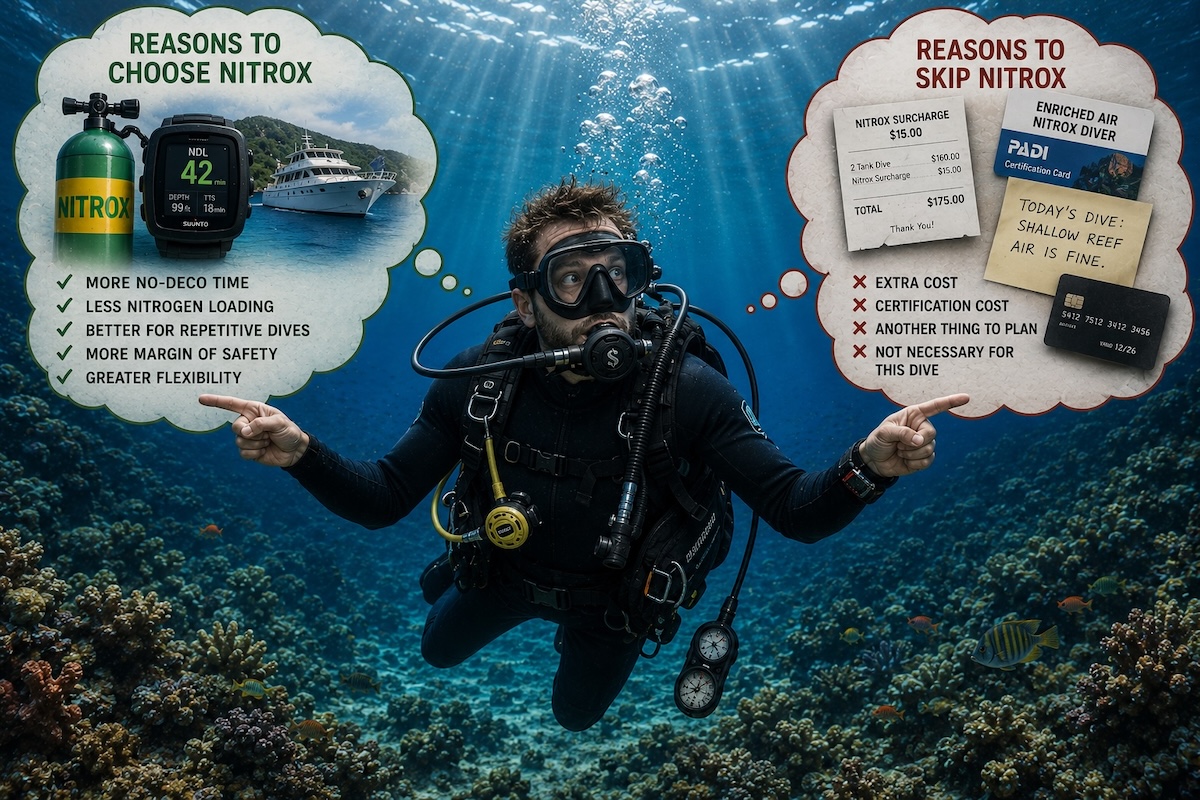
This is where I probably disappoint both the Nitrox evangelists and the anti-Nitrox crowd. I like Nitrox a lot, but I do not use it on every dive. For Open Water checkout dives, Advanced Open Water classes at the quarry, most shallow quarry dives, and dives like Blue Heron Bridge, I usually do not bother.
Could I use Nitrox on those dives? Sure. Would it hurt anything if used properly? No. But at those depths and with those dive objectives, nitrogen is usually not the thing limiting the dive. The dive is more likely to be limited by students, skills, air consumption, current, temperature, visibility, boat logistics, or somebody deciding they have had enough and would like to become dry again.
Nitrox is not a religion. If the profile does not benefit much from it, I do not feel compelled to use it.
When I Absolutely Do
On the other hand, there are dives and trips where Nitrox starts earning its keep very quickly. Cozumel, Grand Cayman, Roatan, liveaboards, North Carolina Megalodon dives, and multi-day tropical trips all come to mind. When you are doing repetitive dives over several days, especially deeper recreational profiles, nitrogen loading becomes a much bigger part of the planning conversation.
One thing I’ve noticed over the years is that divers will spend thousands of dollars on airfare, hotels, dive charters, rental cars, baggage fees, meals, and equipment, then spend twenty minutes debating whether Nitrox is worth the surcharge. Sometimes it isn’t. But when you’re already investing heavily in a dive trip, Nitrox can be one of the least expensive ways to buy yourself a little extra flexibility and margin underwater.
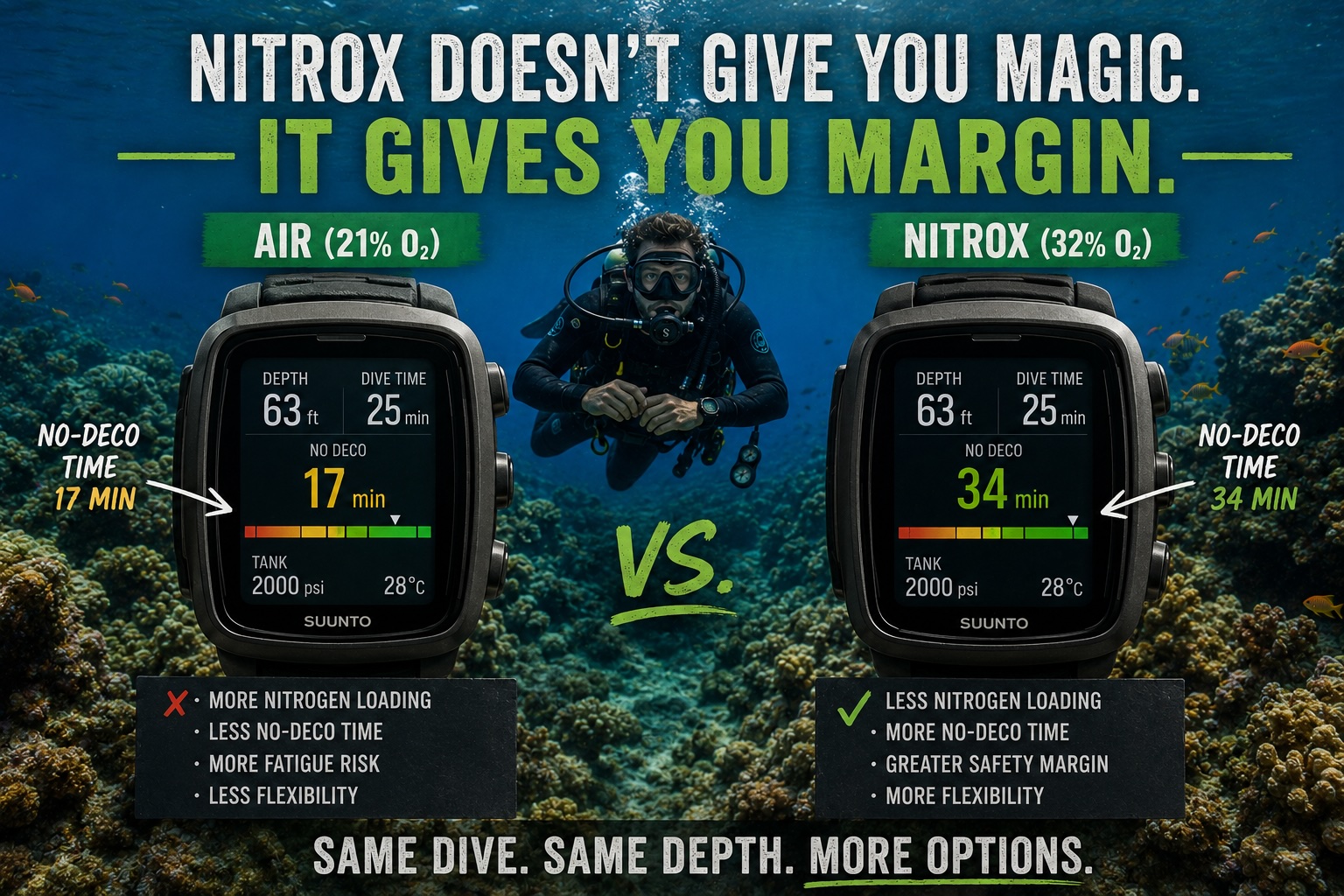
For me, the real value of Nitrox is not just “more bottom time.” That phrase gets thrown around too much and can be misleading. Sometimes Nitrox gives you more usable time at depth. Sometimes it gives you more margin. Sometimes it makes your third or fourth dive of the day feel less constrained. Sometimes it simply gives your computer a little less reason to get grumpy while the dive is finally getting good.
That is how I think about it now. Not as magic time. As margin.
Analyze Your Own Tank
If you take nothing else from this article, take this: when diving Nitrox, analyze your own tank. The operator may have analyzed it. The crew may have written the mix on the tape. The boat may be busy, everyone may be loading gear, and the divemaster may be trying to keep the morning from turning into a circus. Analyze it anyway.
This is not about accusing anyone of being dishonest or incompetent. It is about personal responsibility. You are the one breathing the gas. You are the one setting your computer. You are the one going underwater with that cylinder on your back.
I have had this become weirdly difficult in Cozumel a few times. Not in the Bahamas. Not in the Caymans. Not in Roatan. Specifically Cozumel. I have had operators roll in with tanks, act annoyed when I asked for an analyzer, and tell me they had already checked the tanks. One even suggested that if I cared that much, I should bring my own analyzer.
Nope.
If I had known ahead of time that an operator was going to treat gas analysis like an unreasonable request, I would have chosen a different operator. Verifying your own Nitrox mix is not some diva behavior. It is part of diving Nitrox.
Do You Need Your Own Oxygen Analyzer?
For most recreational divers, no. You do not need to own your own oxygen analyzer. Every reputable Nitrox operator I have worked with provides one, and that is exactly how it should be. The important part is not owning the analyzer. The important part is personally verifying the gas you are about to breathe.
I bought my own analyzer when I became an Enriched Air Nitrox instructor. That made sense for me because I was teaching the course and dealing with Nitrox in a professional context. Technical diving is its own thing, but that is not what we are talking about here. For everyday recreational Nitrox divers, buying an analyzer is usually unnecessary.
Bring your certification card, use the analyzer provided by the operator, verify the mix yourself, mark or confirm the cylinder information as appropriate, and set your computer correctly. That is the habit that matters.
There are dozens of specialty certifications in diving. Some are tied to specific environments, specific activities, or gear you’ll only use occasionally. Nitrox is different. Eventually, most active divers encounter exactly the problem it helps solve. You may not need it today. You may not need it next year. But if you travel enough, dive enough, or spend enough time watching your no-decompression limits disappear on a beautiful dive, you’ll eventually understand why Nitrox became one of the most popular specialty certifications in recreational diving.
So, Should You Even Bother With Nitrox?
If you only do a couple of shallow dives a year, maybe not. If most of your diving happens in shallow quarries or training environments where nitrogen is not the limiting factor, Nitrox may not change your life. There is no shame in that. Air has been working pretty well for a long time.
But if you travel to dive, do repetitive dives, enjoy deeper recreational profiles, book liveaboards, dive walls, chase Meg teeth, or spend several days in a row trying to squeeze the most out of an expensive dive trip, Nitrox is one of the most useful specialty courses you can take.
Not because it guarantees more bottom time. Not because it eliminates risk. Not because it somehow makes you a better diver. Nitrox is worth understanding because it gives you another tool for managing your dive profile, your nitrogen exposure, and your available margin.
Sometimes you will decide it is not worth the extra money.
Sometimes you will be very glad you had it.
The value is knowing the difference.
Frequently Asked Questions About Nitrox
Is Nitrox worth it for recreational divers?
For many divers, yes. If you travel, make repetitive dives, enjoy deeper recreational profiles, or spend several days diving in a row, Nitrox can provide meaningful benefits. If you only make occasional shallow dives, the difference may be minimal.
How much longer can I stay underwater with Nitrox?
That depends entirely on the depth and dive profile. Sometimes the difference is negligible. On other dives, especially deeper recreational dives, Nitrox can noticeably extend no-decompression limits.
Can a newly certified Open Water diver use Nitrox?
Absolutely. Nitrox certification is often one of the first specialty certifications divers earn because the concepts are approachable and the certification is useful almost anywhere recreational diving is offered.
Does Nitrox reduce the risk of decompression sickness?
When used appropriately, Nitrox can reduce nitrogen exposure compared to diving the same profile on air. However, Nitrox does not eliminate decompression sickness risk and should never be treated as a guarantee of safety.
Is Nitrox more expensive than air?
Usually, yes. Many operators charge a small surcharge for Nitrox fills. Whether that additional cost is worth it depends on the type of diving you are doing and how much value you place on the additional flexibility it can provide.
Think Nitrox Might Be Right For You?
If you’ve made it this far, you’ve probably figured out that I’m a fan of Nitrox. Not because it’s magic, but because it can be an incredibly useful tool when the dive profile calls for it.
If you’d like to earn your Nitrox certification and learn how to use the gas safely and confidently, I’d be happy to help.