DAN, PADI, and NAUI: What the Heck Is Going On?
A diver’s guide to understanding the insurance dispute behind the headlines
Editor’s Note: This article reflects publicly available information as of June 2026. Legal proceedings are ongoing, and specific facts, court filings, and judicial rulings may evolve over time.
The plot just thickened, and we finally know exactly what fine print DAN Risk Retention Group (DAN RRG) is pointing at. As first reported by Dive Magazine, DAN RRG’s federal filing outlines two major arguments to avoid paying for the defendants’ legal bills or final damages.
First, they argue that the severe allegations in the Harrison lawsuit (which include standard violations and supervision lapses) fall under explicit policy exclusions, meaning the conduct isn’t covered. Second, they argue that agencies like PADI and NAUI are only listed as “additional insureds,” a highly restrictive status that DAN claims doesn’t cover systemic or corporate negligence claims. If the court agrees, it could completely change how professional dive insurance is written, priced, and restricted moving forward. You can view the ongoing media brief via Dive Magazine or track the paperwork on the Justia Federal Docket.
After wrapping up an Open Water class this morning, I was hanging around chatting with a few friends. As often happens when divers get together, the conversation bounced all over the place before somebody suddenly said:
“Hey, did you hear DAN is suing PADI and NAUI?”
My immediate reaction was pretty much:
“What?”
Of all the things I expected to hear that morning, that wasn’t on the list. What exactly could DAN possibly be suing PADI and NAUI for?
One of the folks in the conversation happens to be a lawyer and tried to explain it to me. He did his best. Unfortunately, my years of legal education were spent very deliberately not attending law school, so I got lost somewhere between the second and third legal term.
Still, the conversation stuck with me. If I was confused, I figured I probably wasn’t the only diver scratching his head over the headlines. Depending on where you look on social media or local forums, the story sounds anywhere from mildly concerning to full-blown scuba industry civil war.
So I did what I usually do when something doesn’t make sense: I started reading. This article is my attempt to explain what appears to be happening in plain English.
My goal here is not to take sides, assign blame, predict outcomes, or tell you who should win. The courts will sort that part out. I simply want to answer a question a lot of divers seem to be asking right now: What exactly is going on with DAN, PADI, and NAUI?
If you finish this article convinced that I have a fish in this dive, then I’ve probably failed. Let’s start with what we know.
A quick disclaimer before we dive into the deep end: To be absolutely clear, I am not an attorney. I am an engineer and a scuba instructor. I look at the world through the lenses of structural systems, standard operating procedures, and risk management, rather than case law. I don’t know jack about the finer points of corporate litigation, but I do know how to read a court filing, and I want to share what I’ve learned from looking directly at the public records.
First, This Didn’t Start With DAN
The current legal dispute traces back to a tragedy that occurred during a scuba certification course in Texas on August 16, 2025. A 12-year-old student named Dylan Harrison passed away during training dives conducted as part of an entry-level scuba certification program.
Following Dylan’s death, her family filed a 40-page civil wrongful-death lawsuit. The lawsuit names numerous defendants connected to the training, supervision, operation, and certification process. Those defendants include the individual dive professionals involved (including instructor William Armstrong, who also faces separate criminal charges), the local dive center (ScubaToys), the training facility (The Scuba Ranch), and the training agencies under whose banners the course operated (PADI and NAUI).
That civil lawsuit is the foundation underneath everything else currently making headlines. Think of the wrongful-death lawsuit as the main event. Everything we’re discussing in this article is happening because of that lawsuit, not instead of it. Without it, none of the current legal maneuvering would exist.
So Is DAN Actually Suing PADI and NAUI?
Technically? Yes.
Practically? Not in the way most people think.
This is one of those situations where the headline is technically accurate but potentially misleading. If you stop reading after “DAN sues PADI,” you’re probably going to walk away with the wrong impression.
On June 16, 2026, a case was officially filed in the U.S. District Court for the Northern District of Texas: DAN Risk Retention Group, Inc. v. PADI Americas, Inc. et al (Case No. 3:26-cv-01976).
When most people, okay, well, divers, hear that one organization is suing another, they imagine something like this: “I think you did something wrong, and now I want you to pay me money.” That’s the standard lawsuit model most of us are familiar with.
This is something entirely different. The court explicitly categorizes this case’s nature of suit as Contract: Insurance. It is what lawyers call a Declaratory Judgment Action. That sounds intimidating, but the underlying idea is actually pretty simple.
Imagine you and I sign a business contract. A year later, a major accident happens. Now, we’re both pointing at different paragraphs in that contract and insisting they mean completely different things. Instead of waiting around until we’ve spent millions of dollars fighting each other blindly, one of us goes to a federal judge and says: “Can you please read this and tell us what this contract actually means?”
That’s essentially what a declaratory judgment action is. One party asks a court to officially clarify legal and financial obligations before the larger dispute moves forward. Think of it less as a personal fight and more as asking a referee for an official interpretation of the rulebook.
Wait… Which DAN?
It helps to clear up a common point of confusion here. Most of us think of DAN as the organization that answers emergency calls, coordinates medical evacuations, funds dive research, and provides diver health insurance.
In this case, however, the plaintiff isn’t Divers Alert Network acting in its medical or educational capacity. The plaintiff is DAN Risk Retention Group (DAN RRG), an insurance company affiliated with the broader DAN organization.
That distinction matters because the case isn’t really about dive medicine, safety training, or emergency response. It is strictly about insurance obligations. Half the divers reading the headlines think the chamber network is actively targeting PADI, when they are actually reading about a corporate insurance dispute.
Why Is Insurance Suddenly Involved?
Because lawsuits are expensive.
Really expensive.
Most of us think about lawsuits in terms of the final outcome: somebody wins, somebody loses, and somebody writes a check. Lawyers, however, tend to think about a different question first: Who is paying for all of this while the lawsuit is still happening? That’s where insurance enters the picture.
When a major wrongful-death lawsuit lands, one of the first questions everyone starts asking is: Who is responsible for paying for the defense right now? That’s where things get complicated.
In reality, insurance becomes critical almost immediately because lawyers cost money whether you win or lose. The meter starts running long before any verdict arrives.
Two Insurance Concepts Worth Understanding
To understand why this case matters, it helps to understand two basic insurance concepts. Don’t worry, this won’t be on the final exam.
1. Duty to Defend
This is exactly what it sounds like. If an insurance company has a “duty to defend” you, it generally means they are responsible for providing or paying for your legal representation right now. Lawyers, court filings, depositions, expert witnesses, and all the costly elements that come with modern litigation fit into this category. You can think of this as: “Who pays for the ongoing legal battle?”
2. Duty to Indemnify
This is a completely different question. This asks: “If somebody loses at the end of the trial, who pays the final bill?” Let’s say a court awards damages or the parties reach a financial settlement. Somebody has to write that check.
Insurance policies address both duties, but they are not the same thing. An insurer might have a duty to defend a policyholder in court, but they might not have a duty to indemnify them if the court finds they did something completely outside the bounds of the policy. Determining exactly which obligations exist is often where insurance disputes begin.
So What Is DAN Asking the Court to Decide?
When this case was first filed, the specific policy provisions in question were still under wraps. However, as noted in the breaking update at the top of this article, recent reporting has revealed exactly what provisions DAN RRG is asking the court to interpret. The court’s ultimate ruling on those questions remains to be seen.
Reports from industry publications like Divernet and X-Ray Mag have highlighted the severe allegations outlined in the Harrison family’s underlying lawsuit, including claims regarding instructor fatigue, supervision lapses in low visibility, delayed emergency response times, and missing dive computer data. Many liability policies contain exclusions for certain types of conduct or circumstances.
Based on the nature of the filing and the public reporting surrounding it, DAN RRG appears to be asking the court to clarify what obligations exist under various insurance policies connected to the defendants in the underlying lawsuit. In practical terms, that likely means determining whether the allegations in the underlying lawsuit trigger policy exclusions or create obligations to provide a defense, indemnification, or both.
You might also wonder why both PADI and NAUI find themselves listed as co-defendants on the exact same insurance docket. It is not because they were running a joint class. Rather, because those agencies, businesses, and individuals were all named in the underlying lawsuit, they also appear as defendants in this insurance action. The court can’t readily determine coverage obligations without having all of the potentially affected parties in the room.
To be clear on what this lawsuit is not doing:
- DAN is not trying to prove anyone is innocent.
- DAN is not trying to prove anyone is guilty.
- DAN is not trying to win the underlying wrongful-death lawsuit.
Those are different questions for a different court. The issue here is a contract question, not a liability question. At least not yet.
Why This Matters Beyond the Courtroom
At this point, you might be thinking: “Okay Frank, but I’m just a recreational diver. Why should I care about a corporate insurance dispute?”
Fair question. You should care because insurance quietly dictates almost every professional activity in the scuba world. Instructor insurance, dive shop liability, charter boat coverage, and facility insurance all exist in the background, making our weekend hobby possible. Most divers never think about it, until something breaks.
Cases like this can influence how insurers evaluate risk across the entire dive industry. They can change the exact wording in future policies, raise insurance premiums for your local shop or favorite instructor, change underwriting requirements, and alter who qualifies for coverage and under what circumstances.
The ripple effects of how a court interprets these policies can extend far beyond a single courtroom in Texas.
Speaking as an instructor, I can tell you the stakes here are incredibly personal. If affordable professional liability insurance disappears, or if the safety net becomes so restrictive that honest professionals feel completely exposed, many of us will simply stop teaching. It is not because we are bad at our jobs or plan on cutting corners. It is because we understand that on a long enough timeline, gear fails, unexpected medical emergencies happen underwater, and accidents occur. If an instructor is left to face a multi-million dollar legal battle completely hung out to dry (even when they did absolutely everything right) that is an existential threat to their family’s financial future. Without that background insurance layer protecting the pros, the pipeline of new entry-level classes could dry up fast.
What We Don’t Know
One thing I want to be careful about is separating documented facts from online speculation. The internet is currently overflowing with rumors. The courts, however, are still working through facts.
At this stage, there are many major questions that have not yet been answered:
- We do not know how the underlying wrongful-death lawsuit will ultimately be resolved.
- We do not know how the federal court will rule regarding DAN’s insurance obligations.
- We do not know whether out-of-court settlements will occur.
- We do not know what long-term structural effects, if any, this case may have on youth diver training or industry safety regulations.
Anyone claiming absolute certainty right now is getting way ahead of the process.
The Big Takeaway
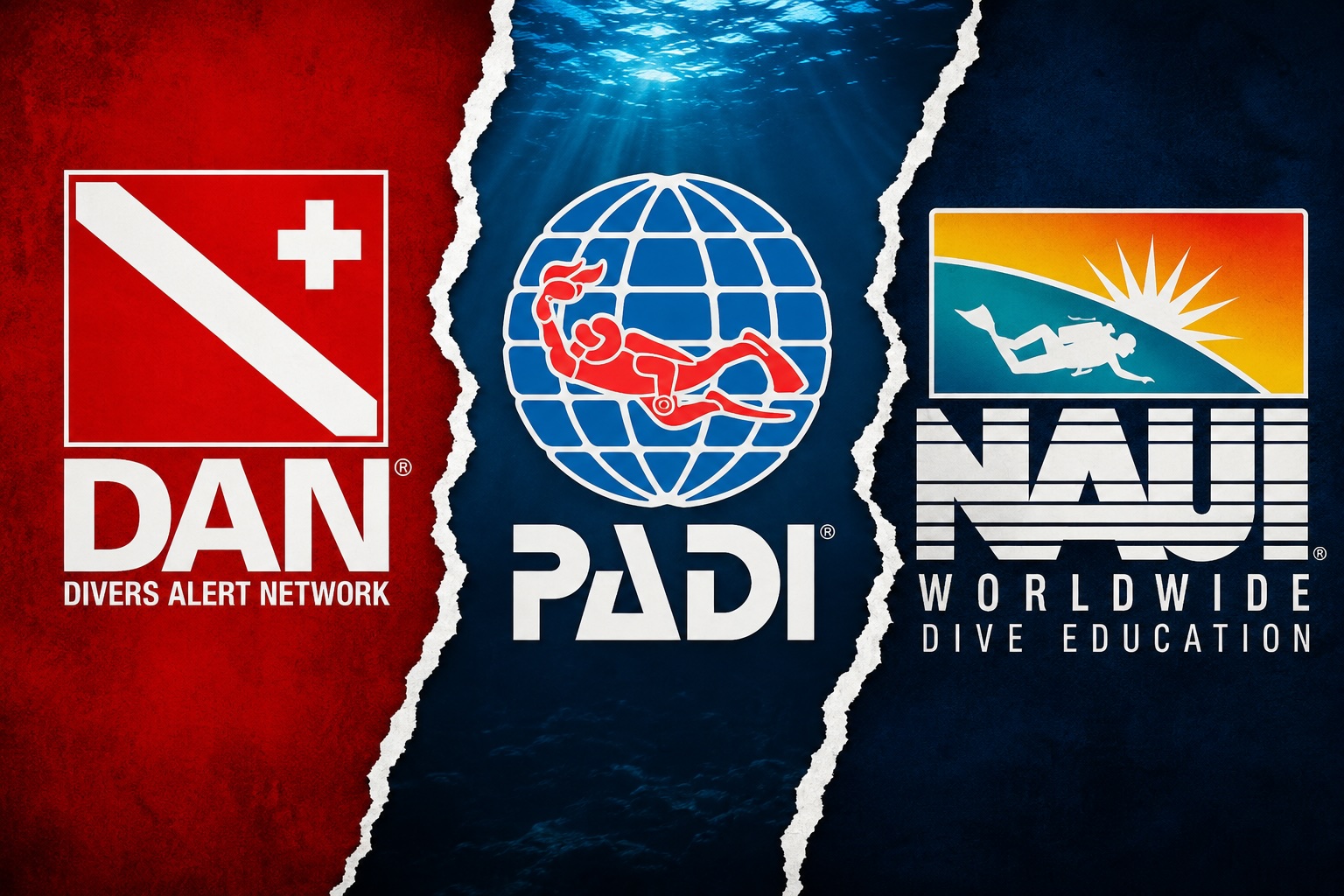
The clickbait headlines make it sound like DAN, PADI, and NAUI have suddenly entered some kind of underwater cage match. That’s not really what’s happening.
A tragedy occurred. A wrongful-death lawsuit followed. Complex insurance questions emerged. Now, a court is being asked to clarify who has what obligations under a set of corporate contracts. That may not be as exciting as the internet rumors, but it is considerably closer to reality.
Most of us only encounter the diving industry from the customer side. We sign waivers, take classes, rent gear, climb onto boats, and go diving. Behind the scenes, though, there’s an entire ecosystem of insurance policies, legal agreements, standards, certifications, and risk management processes quietly holding everything together. Most of the time we never notice any of it. Cases like this briefly pull back the curtain.
For now, the best approach is probably the exact same approach we use underwater: Slow down. Look carefully. Avoid jumping to conclusions. And pay attention to what actually happens rather than what people assume is happening.
- If you want to view the background details on the incident, check out Divernet’s reporting on the family’s initial lawsuit.
- If you want to track the official federal docket as it progresses through the legal system, you can view the case updates directly via Justia Dockets: DAN Risk Retention Group Inc v. PADI Americas Inc et al.