Why AOW? From Brand-New Duckie to Thinking Like a Diver
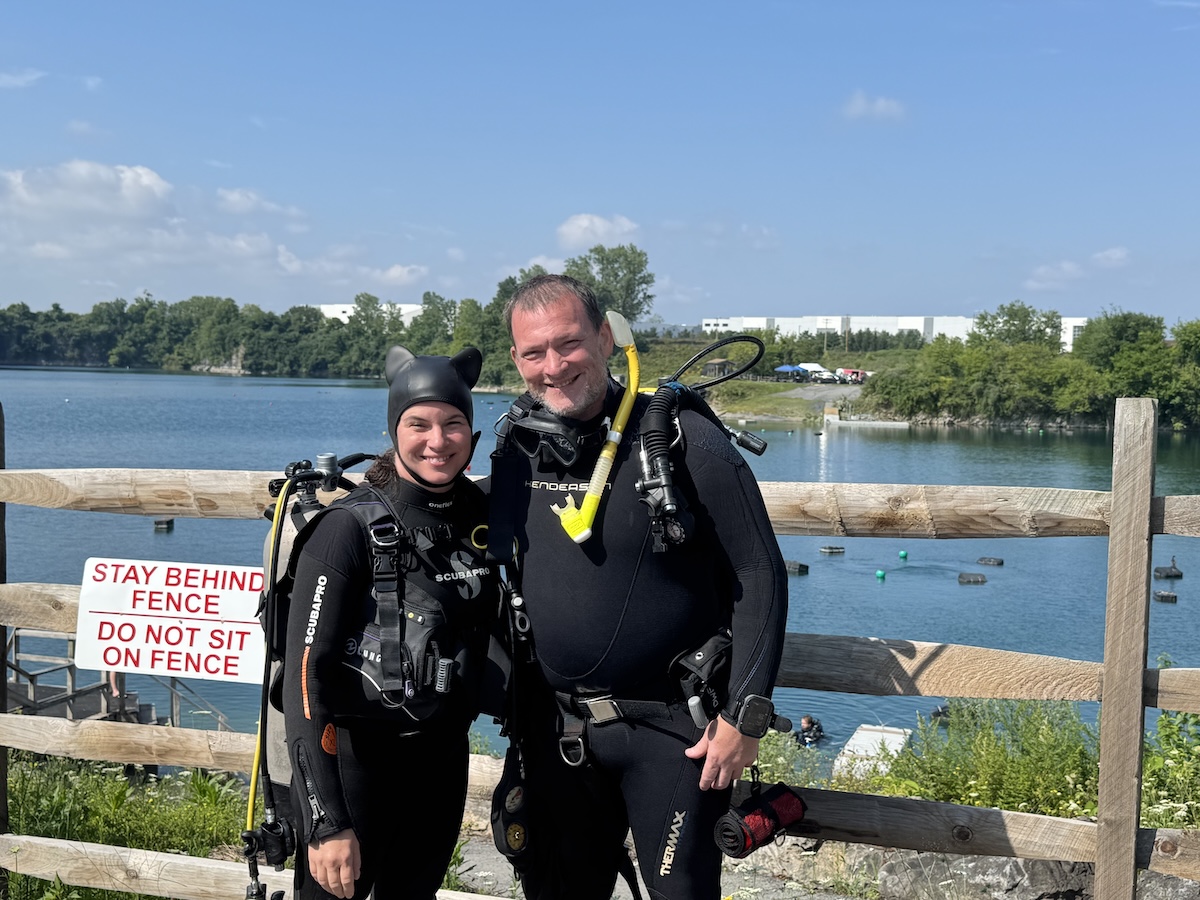
When I took my own Advanced Open Water course years ago, I was not thinking about C-cards or prestige. I was just insanely hyped. I wanted to sample everything. Night diving? Yup, sign me up, I wanted to hunt lobsters. Deep diving? Heck yeah, I did not like limits. Wreck? Absolutely. Buoyancy? Yeah, mine kinda sucked back then. Navigation? I needed that one way more than I possibly understood at the time. I was not trying to flex or feel elite; I was just genuinely excited to see so many new facets of diving packed into a handful of dives.
That genuine curiosity is still the best way to enter the course.
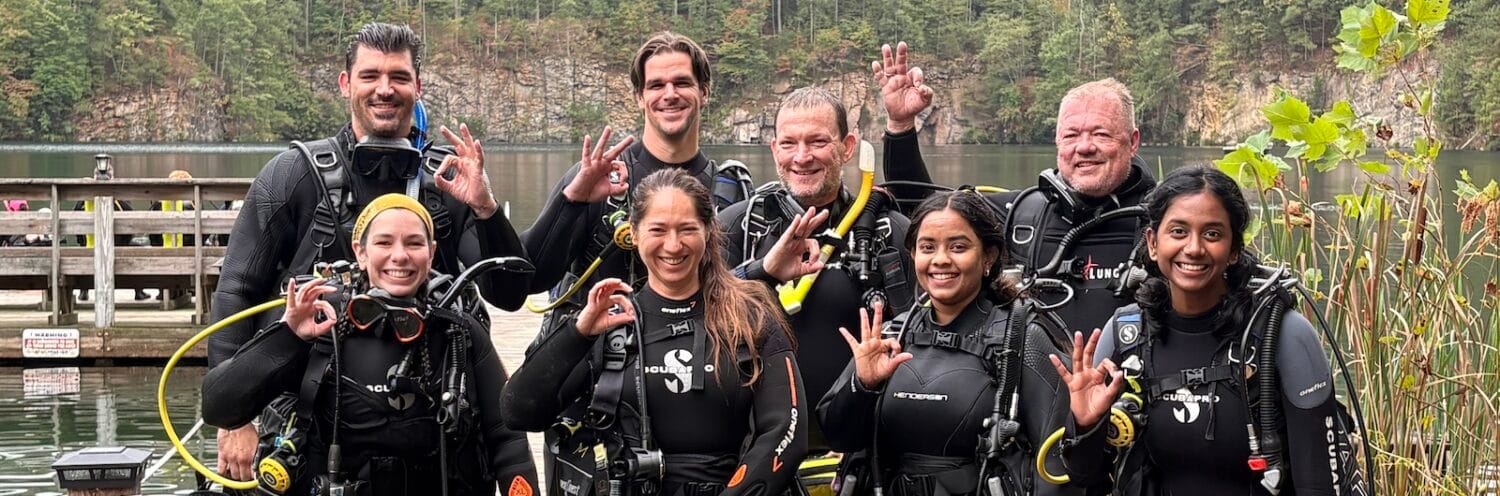
I found myself thinking about that again this weekend while standing at the quarry with another Advanced Open Water class. The students change, the gear changes, and I have considerably more gray hair, but the point of the course really has not changed: you are there to stretch.
The 15-Second Answer
Advanced Open Water does not magically turn you into a deep-sea commando. It is really just Open Water Plus. The goal of five Adventure Dives is not mastery, but rather giving you a structured environment to build real-world experience, expand your task loading, and start taking ownership of your own diving.
Instead of treating AOW as a refresher course or an elite badge, use it as a practical laboratory to sharpen your buoyancy, navigate with confidence, and understand what happens when your physical margins get smaller at depth. You leave the course not as a finished expert, but as a more confident and capable diver who is starting to take real ownership of what happens underwater.
Ask a non-diver what an “Advanced Open Water Diver” is, though, and the title makes it sound like some kind of underwater commando qualification. You earned the card, so clearly you are now rappelling into black-water caves, wrestling currents, and breaching sunken submarines before breakfast. Not so much.
PADI itself describes Advanced Open Water as a course for divers who want to improve their skills and gain experience. You do not need to already be an “advanced diver” to take it. The course consists of five Adventure Dives, with Deep and Underwater Navigation required and three others chosen based on interests, location, and conditions.
I have a less glamorous description for it: Open Water Plus. And I mean that as a compliment.
What Advanced Open Water Is Actually For
Open Water gives you the foundation. You learn how to use your equipment, control yourself underwater, respond to basic problems, monitor your dive, and operate within the limits of your training. Then you need experience, and lots of it.
Advanced Open Water gives newer divers a structured way to start getting some of that experience while an instructor is still close enough to intervene when things get weird. And things occasionally get weird underwater.
The beauty of AOW is that it lets you try different kinds of diving without pretending you have mastered any of them. Whether it is Deep, Navigation, Wreck, Search & Recovery, Peak Performance Buoyancy, Photography, Night, or Drift, you pick whatever makes sense for where you are diving and what you eventually want to do. It is a sampler platter. You are not becoming a master wreck diver because you completed one Wreck Adventure Dive; you are getting your first guided look at wreck diving and, ideally, discovering both what you can do and how much more there is to learn.
That distinction matters. The plastic card says “Advanced,” but the diver should still be thinking, “Okay, what do I need to learn next?”
The C-Card Trap: AOW Is Not a Refresher
There is another situation I see periodically. Someone earns Open Water on vacation, has a fantastic time, goes home, and then life happens. A year goes by, maybe two, and then they decide to take Advanced Open Water, showing up expecting AOW to knock the rust off.
That can become a problem.
I remember a student arriving for an AOW class years ago while I was still a Divemaster in Training. He had been certified at a tropical resort about a year earlier and had not dived since. By the time he came to us, some pretty fundamental stuff had evaporated. We were not about to start piling navigation, depth, and additional task loading on top of fundamentals that were no longer there.
So everything stopped. We went back to assembling gear, tank orientation, weighting, and basic comfort. Those were the things that needed to be solid before anything “advanced” was going to be useful.
There is nothing embarrassing about getting rusty because these are perishable skills, and PADI specifically recommends refresher training for divers who have been out of the water for a while. But AOW should build on your foundation, not reconstruct it from the concrete slab. If it has been a while, knock the rust off first, then come into AOW ready to stretch.
Why AOW Matters Before Meg Trips
There is also a very practical reason Advanced Open Water matters in the Dive With Frank universe. The offshore charter boats we use for our Megalodon shark tooth trips out of Wilmington, North Carolina, explicitly require both Advanced Open Water and Enriched Air Nitrox certifications for all divers on board. I happen to agree with that policy completely.
The reason is simple: we are hunting Meg teeth in roughly 95 feet of Atlantic Ocean while managing depth, gas, no-decompression limits, current, navigation, fossil hunting, buddy awareness, and whatever else the ocean decides to contribute that morning. That is a lot happening at once.
Nitrox gives us considerably more flexibility with no-decompression limits on those profiles, while AOW gives the boat captain at least some indication that a diver has been exposed to deeper diving, navigation, task loading, and the need to manage more than one thing at a time. Neither card magically makes someone ready, as experience still matters, but I would much rather have somebody work on buoyancy, navigation, deeper profiles, gas awareness, and task loading in a quarry before they are 40 miles offshore with their face buried in the sand looking for a five-inch shark tooth.
That is why I deliberately schedule AOW and Nitrox training close to some of my Meg trips. We build the skills first, then we go use them.
The Quarry Laboratory: Building a Compound Skill Stack
When I run AOW over a weekend at a quarry, I do not pick three elective dives by throwing darts at the PADI course list. I like the dives to build on each other. My preferred stack looks something like this:
Day 1: Peak Performance Buoyancy → Underwater Navigation → Search & Recovery
Day 2: Deep Diving → Wreck Diving
Deep and Underwater Navigation are the required AOW dives, while the other three are electives where what makes sense for one student or location may not make sense for another. But for the kind of diver I am usually trying to build at a quarry, I love this progression because each dive makes the next one easier. Peak Performance Buoyancy frees up cognitive bandwidth for Navigation. Navigation prepares the diver for the heavy task loading of Search & Recovery. Those skills prepare the diver for the shrinking margins of Deep Diving, and Wreck finishes the weekend by demanding observation, boundary awareness, and spatial judgment.
Day 1: The Lung Cheat Code
Before I hand somebody a compass, reel, lift bag, or a pile of additional tasks, I want them comfortable in the water. That is why I love starting with Peak Performance Buoyancy.
A lot of newer divers treat their BCD like the only buoyancy control they have. They start drifting upward, dump a bunch of air, sink, add air, rise again, dump again, and suddenly they are riding an underwater elevator operated by somebody aggressively slapping every button. There is an easier way, and I teach what I call the Lung Cheat Code.
Your BCD handles the bigger buoyancy changes, while your breathing gives you fine control once you are close to neutral. A slightly deeper breath can move you gently upward, while a fuller exhalation can move you gently downward. You are making small corrections without constantly reaching for buttons.
The important word there is small. If you are genuinely positively buoyant and continuing to ascend, you still need to vent your BCD appropriately, and obviously, we never solve a buoyancy problem by holding our breath. The lungs are a fine-tuning tool, not a substitute for understanding your BCD.
Once that relationship clicks, something wonderful happens: the diver stops fighting the water. I wrote an entire article about this because understanding buoyancy as a balance of forces changed the way I personally dive and the way I teach it. Once the diver is not bouncing off the bottom or corking toward the surface, we can start adding other jobs.
Navigation: Trust the Damn Compass
Next comes Underwater Navigation. Compasses frustrate new divers because they are trying to solve three problems at once: Where am I going? What is my depth? Why am I sinking?
If buoyancy is consuming half your brain, there is not much brain left for headings, kick cycles, natural references, and remembering which direction you just came from. Once the diver settles down physically, navigation starts making considerably more sense. Point the lubber line where you want to go, keep the body behind it, trust the compass, and stop trying to negotiate with north. It works. When students start returning to where they intended to return instead of surfacing 150 yards away and pretending that was the plan all along, confidence grows fast.
Search & Recovery: Now Add Work
By the time we reach Search & Recovery, I start piling things on. Now you have to maintain buoyancy while navigating a search pattern, keep track of where you have been, work with a line, tie knots, locate an object, rig a lift bag, and communicate with a buddy.
This is where the earlier dives start paying rent. The student is no longer practicing one isolated scuba skill; they are solving a problem underwater. That transition is important because real dives rarely present one tidy little problem at a time.
Real diving is messy. The current changes, your buddy gets distracted, you lose the line, your computer beeps, your mask starts leaking, and you realize the thing you are looking for is apparently the exact same color as the entire quarry floor. Good divers learn to keep thinking while all of that is happening.
Choosing Electives With a Purpose
PADI gives students a pretty wide menu of Adventure Dives, and that is one of the things I genuinely like about the program since the course can follow the diver’s interests. But when I am teaching a concentrated quarry weekend, I have my favorites. This is not because the other Adventure Dives are bad, but because I am simply trying to squeeze as much useful in-water skill development as possible out of five dives.
- Nitrox: I love Nitrox, require it on my Meg trips, and wrote an entire article about why it is useful. However, I usually prefer teaching Enriched Air as a standalone course rather than using one of our AOW water slots for it. Much of the important work involves analyzing cylinders, understanding oxygen exposure and maximum operating depth, and correctly setting the dive computer. Underwater, breathing Nitrox feels suspiciously like breathing air. So if I have a limited number of quarry dives available, I would rather use those dives for something that creates more physical work underwater and teach Nitrox alongside the weekend.
- Drift, Boat, and Night: Environment matters too. A real Drift Adventure Dive requires actual moving water, boat diving requires a boat, and night diving requires a site, schedule, and conditions that make night diving practical. I am not interested in forcing an Adventure Dive into a weekend just because its name happens to exist on a list. Use the environment you actually have.
- Fish Identification: Fish ID can be a terrific dive, especially for someone who loves marine life and wants to become a more observant diver. It is simply not what I usually prioritize during a quarry-based AOW weekend focused heavily on physical diving skills and task loading. Different goal, different class.
- Underwater Photography: Photography is the interesting exception. People sometimes wonder why anyone would practice underwater photography in quarry visibility when tropical reefs exist: it is because bad conditions expose bad habits. Put a camera in the hands of a newer diver and watch what happens. The camera becomes the most fascinating object in the known universe while depth, buddy, SPG, and buoyancy disappear into target fixation. If you can maintain trim, monitor your gas, watch your depth, avoid destroying the bottom, keep track of your buddy, and still compose a decent image in marginal visibility, you are learning something useful. Then when you finally get that beautiful 100-foot tropical visibility, everything feels easy.
Day 2: The Margin Gets Smaller
Day 2 is when I turn up the seriousness. Not the fear, the seriousness. I do not think terrifying somebody before their first deeper training dive accomplishes much. My job is not to make a diver afraid of depth; my job is to make sure they respect what changes when they go there.
At 80 feet, ambient pressure is roughly 3.4 atmospheres. For the same surface breathing rate, you are moving through roughly 3.4 times as much gas from your cylinder, and if you start working hard, gas consumption rises even faster. DAN’s gas-consumption guidance makes the same basic point: greater depth and greater exertion both increase breathing-gas demand.
The margin gets smaller. Your wetsuit has compressed, your buoyancy characteristics have changed, your gas is disappearing faster, you have farther to travel if you need to ascend, and your no-decompression time is shorter. Furthermore, your breathing gas is denser, and hard work can make breathing and carbon dioxide elimination more difficult.
None of that means 80 feet is some terrifying abyss; it simply means you need to pay attention.
Buoyancy mistakes can compound quickly. As you ascend, gas in your BCD expands, and if you let an ascent start running away without controlling it, it can accelerate as you get shallower. Uncontrolled rapid ascents can create serious risks, including pulmonary barotrauma and arterial gas embolism. Depth does not need to scare you, but it does deserve your respect.
Case Study: Anatomy of a Panic Spiral
Years ago, I watched that margin collapse astonishingly fast. We descended to roughly 80 feet, and one diver wanted to stop his descent and stabilize. Instead of adding the small amount of air he needed to establish neutral buoyancy, he started kicking hard, essentially trying to swim upward just to stay in place.
That created the next problem: hard work means increased oxygen demand and increased carbon dioxide production. At depth, breathing gas is denser and the work of breathing increases, a combination that can make CO2 management increasingly difficult when a diver exerts himself. DAN specifically identifies gas density and workload as important factors in work of breathing and CO2 elimination.
I obviously did not have a blood-gas analyzer strapped to the guy, so I cannot tell you exactly what his CO2 level was, but I can tell you what I watched happen. His breathing rate climbed, his situational awareness collapsed, and then the breathing alarm in his brain appeared to take over everything else. CO2 is a major driver of the urge to breathe, and when that sensation gets strong enough, a diver can feel desperately air-starved even when plenty of breathing gas remains available.
His cylinder was nowhere near empty, but that did not matter anymore. He gave me the out-of-air signal, started hyperventilating, and tried to head for the surface. The entire progression happened amazingly fast.
Because I was right beside him, I was able to intercept the ascent, establish control, and get us safely back to the surface. And that was the end of the dive. He was physically and emotionally cooked, so continuing would have accomplished absolutely nothing. It was a stark lesson for everyone on the shore: depth doesn’t give you second chances when you try to muscle your way through bad buoyancy.
That experience has stayed with me because there was no single cinematic equipment failure. Nothing exploded, a regulator did not fall apart, and nobody ran out of gas. A small buoyancy problem became physical exertion, physical exertion became respiratory distress, respiratory distress became fear, and fear became panic.
That is task loading in the real world, and it is one of the reasons I care so much about boring little things like buoyancy control before we start adding depth, reels, cameras, searches, wrecks, and everything else.
The Wreck Dive: Learning Where the Boundary Is
We finish the weekend with Wreck. For the way I teach the AOW Wreck Adventure Dive, the goal is not penetration. The goal is awareness.
I want students looking at the structure. Where are the hazards? What is sharp? What could collapse? Where is fishing line likely to collect? What areas could trap you? What happens to visibility if somebody kicks up the bottom? Where would you go if something went wrong?
Wreck diving becomes a very different activity once you start talking about entering an overhead environment. PADI’s dedicated Wreck Diver course builds further skills involving wreck surveys, lines and reels, specialized techniques, and responsible wreck exploration. One introductory wreck dive does not magically hand you all of that, so I actually consider it a successful AOW Wreck dive if the student finishes thinking, “Wow. There is a lot more to this than I realized.”
Exactly. Welcome to diving: the more you learn, the bigger the ocean gets.
Start Thinking Like a Diver
That is ultimately what I want out of Advanced Open Water: not an “advanced diver” after five dives, but somebody who is beginning to take ownership of what happens underwater.
Check your own gas. Watch your own computer. Know your depth. Understand where you are. Notice what your buddy is doing. Recognize when something feels wrong before it turns into something bigger.
Open Water gives you the foundation, while Advanced Open Water starts asking you to use it while other things are happening. That is the shift. The plastic card is nice since it opens doors to some dives, trips, and additional training, but the real accomplishment is quieter than that.
You start looking around. You start noticing things. You stop simply following the instructor’s fins and start understanding the dive. You start thinking like a diver, and that is where things really start getting fun.