Why Visibility Matters More Than Most Divers Think
Sharing the Depth: A Reflection on Focus, Clarity, and What the Soup Teaches Us
Ask a diver how a dive went, and if they saw a hammerhead shark, a massive bait ball, or a historic wreck, that wildlife is obviously the first thing out of their mouth. But once the initial excitement fades, or if the marine life decided not to show up, the very next topic on the boat deck is guaranteed to be the visibility.
To non-divers, this obsession sounds ridiculous. Unless a massive fog bank rolls in during your outdoor event of choice, or we are talking about downtown Los Angeles in the 1970s, visibility on land does not undergo massive, unpredictable swings. You can generally see whatever you want or need to see. Yet divers obsess over it. There is a good reason for that: visibility does not just change what you can see, it completely alters your mental bandwidth and the mechanics of the entire dive.
Shifting Horizons: From Kelp to Quarries
I learned to dive in Southern California, specifically in the kelp forests off the coast. If your image of scuba diving comes entirely from vacation brochures or glossy travel magazines, you probably picture crystal-clear blue water stretching off toward infinity. That was not my experience. Where I learned to dive, thirty feet of visibility was a spectacular day.
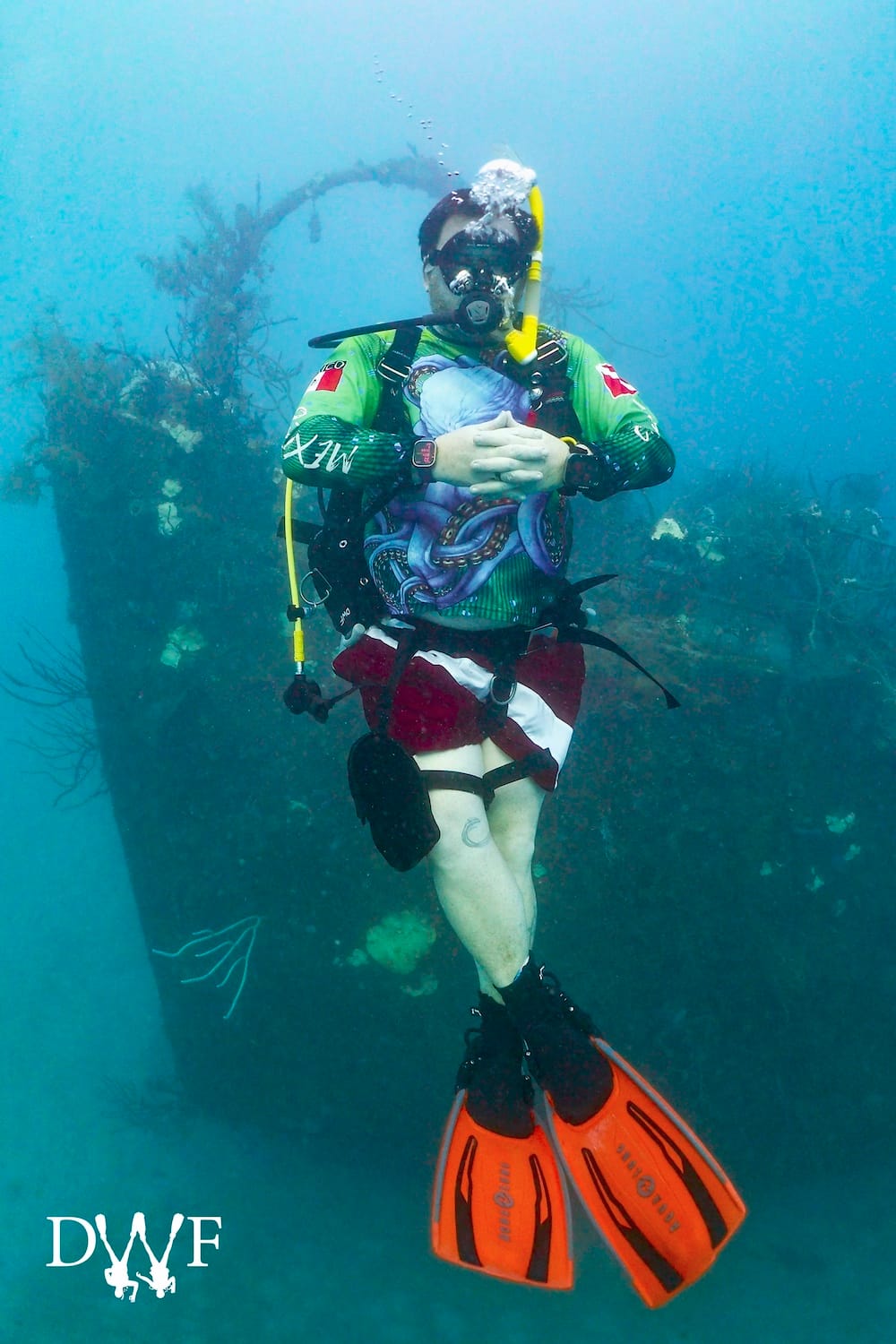
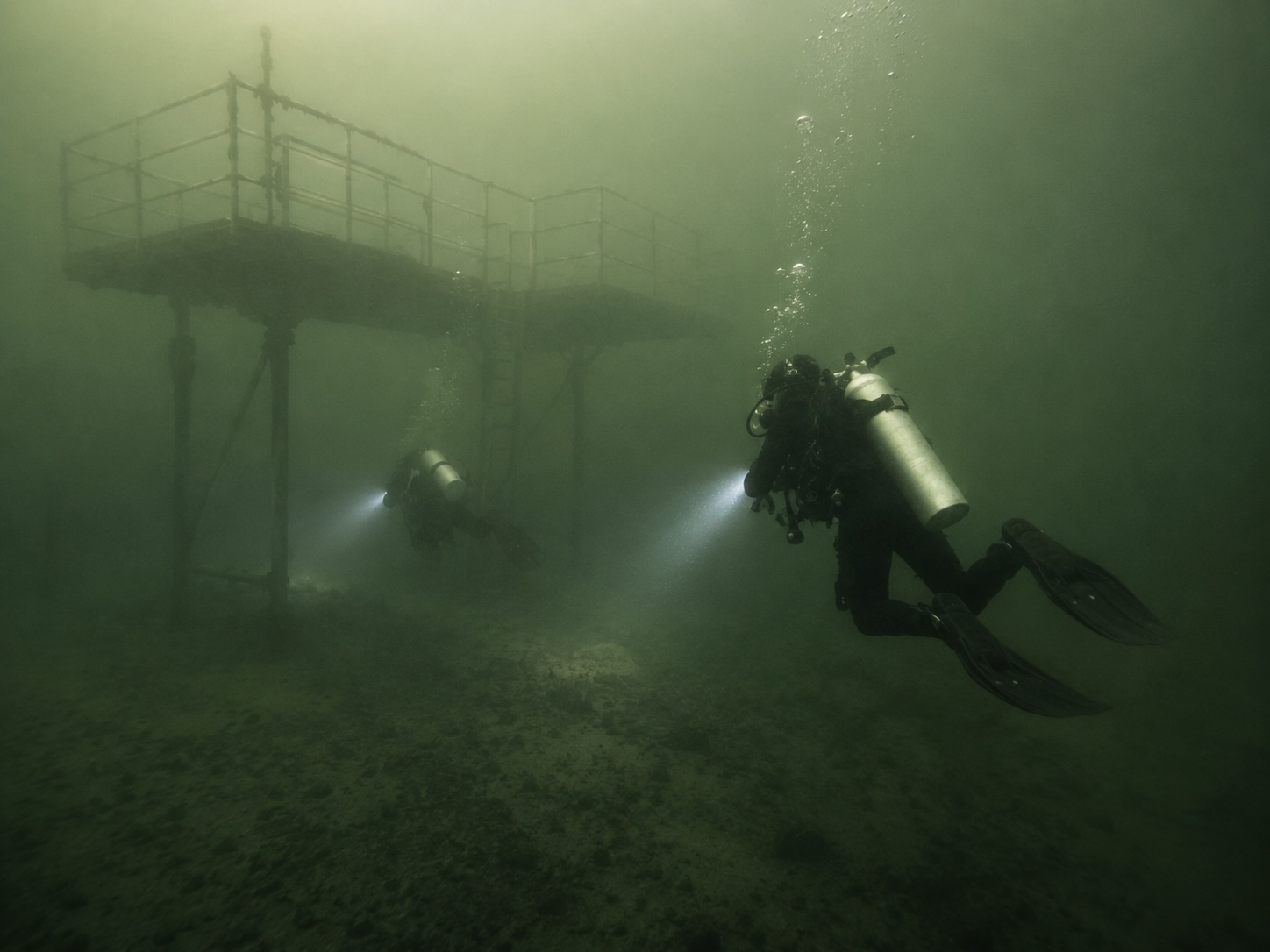
Then I moved to Maryland, and suddenly thirty feet sounded downright luxurious. Many of my local dives took place in quarries where the visibility could easily be cut in half, or worse. I remember teaching classes on a ten-by-ten-foot underwater platform with five students and another instructor. We positioned ourselves on opposite corners of that exact same small platform and literally could not see each other. Ten feet away, and totally gone. Local diving has a funny way of making you realize that visibility dictates every single choice you make underwater.
“It Builds Character”
Remember when you were a kid and something crummy happened, and your mom or dad would say, “Suck it up, it builds character”? Well, dropping into the absolute soup does exactly that. In poor visibility conditions, you quickly learn to develop actual skills. You learn real navigation, intense buddy awareness, and a strict mental mapping of landmarks and terrain features. If you don’t, you may not see what you want to see, go where you want to go, and you almost certainly will be in for an incredibly long, exhausting surface swim at the end of your dive.
The funny thing is that many divers who train in low-visibility environments do not realize how much those conditions are quietly teaching them because they are too busy dealing with the immediate stress of the environment. Only later do they realize they were building world-class discipline the entire time.
It all comes down to your brain’s processing power. In poor visibility, your mind is constantly redlining just to track your buddy, your heading, and your depth all at once. Then you drop into exceptional visibility, and the biggest surprise is not how pretty the water looks, but how much easier it is to think clearly.
Good visibility does not automatically make you a better diver, but it completely changes the math by giving your brain critical information much earlier. Exceptional clarity simply lowers the tax on your working memory, freeing up the cognitive reserves you normally spend just trying to handle the environment.
Experiencing the Absurd Blue Water
Years after learning to dive, I booked my first liveaboard in the Bahamas. By then, I had plenty of dives under my belt, but to my surprise, I was incredibly nervous. It was not because of the diving itself, but because I was convinced everybody else on the boat knew some secret to blue-water diving that I had somehow missed.
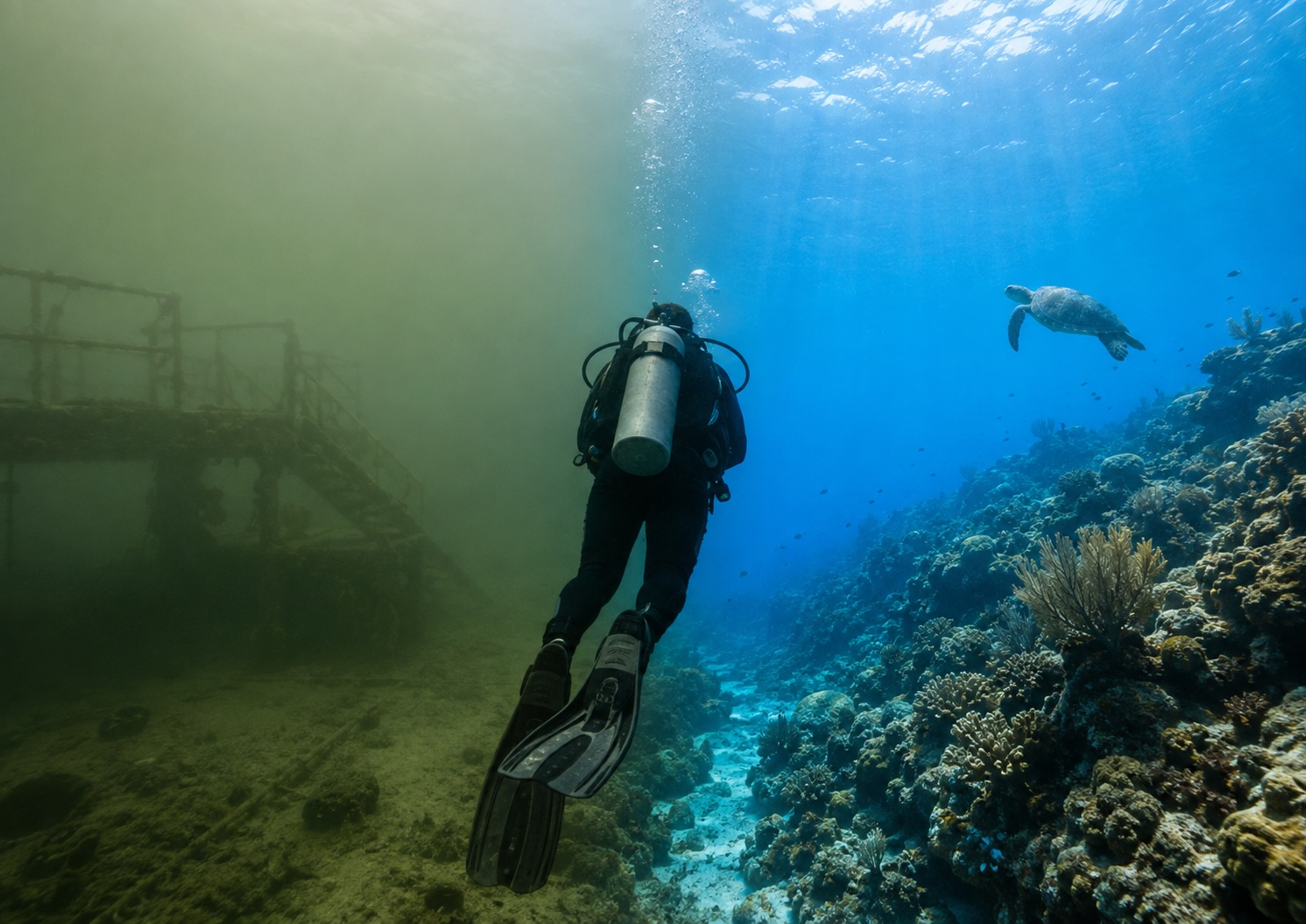
The anxiety turned out to be for absolutely nothing. The visibility was absurd. I could see hundreds of feet, watching divers scattered throughout the water column and reef structures stretching off into the blue.
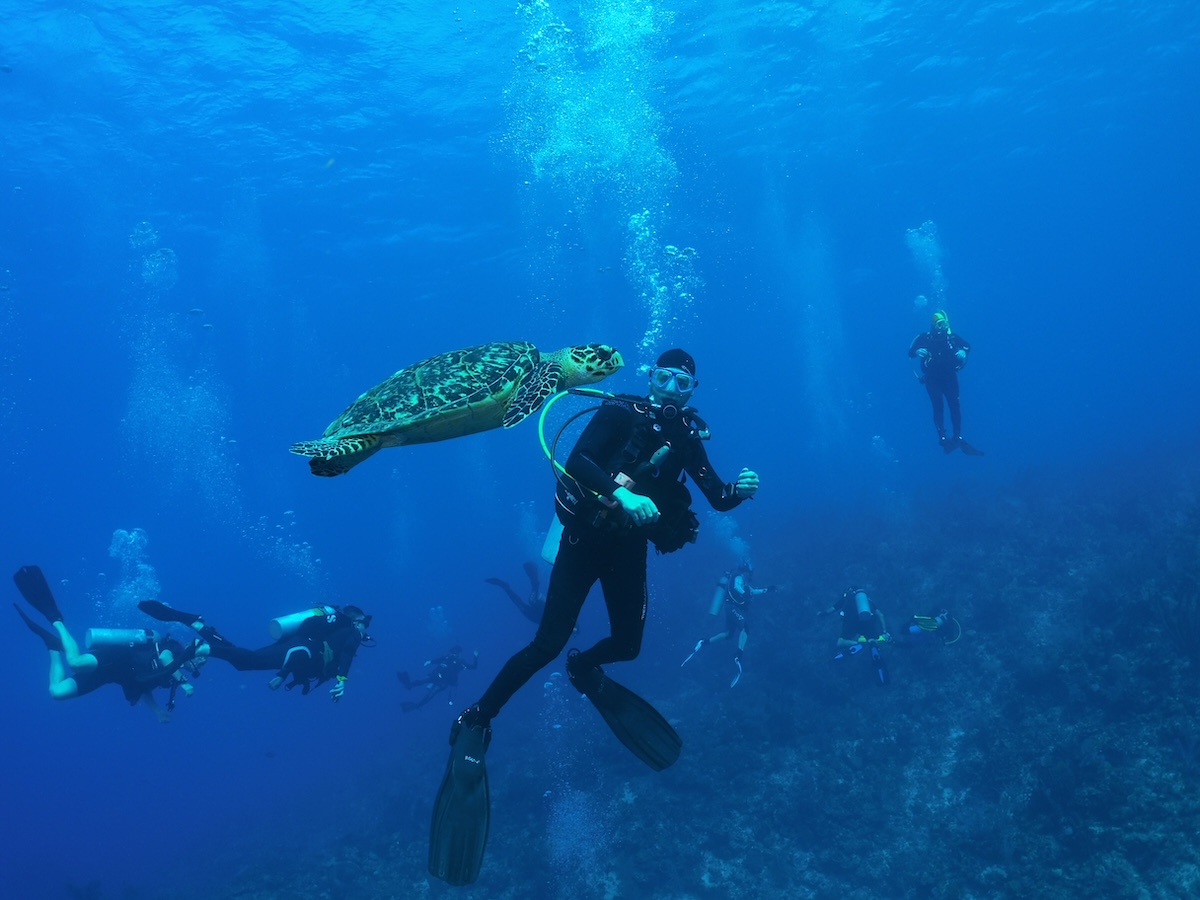
I could see sea turtles long before I got anywhere near them. In fact, I spent a good portion of that trip staring at turtles that always seemed just a little farther away than I thought they were. One thing newer divers do not immediately appreciate, and older divers sometimes completely forget, especially when excited by a turtle, is that water magnifies things, making objects appear closer than they really are. That is why experienced photographers eventually stop trying to sprint toward every interesting thing they see.
If I turbo across half the reef toward a turtle, I will burn air, work harder than necessary, and the turtle will be gone by the time I get there anyway. Except for Bob, of course. Bob apparently has some sort of diplomatic immunity with sea turtles, but the rest of us have to play by the rules of physics.
The Underwater Wizard and the Reality of Dutch Springs Lake Hydra
You might think the most magical thing I have ever seen emerge from poor visibility was a giant fish, a shark, or a historic wreck. Nope. It was my destination.
Most experienced divers know this exact feeling. You are swimming along, following your compass, following your plan, and secretly wondering if you have gone too far or screwed up the entire pattern. Then, suddenly, there it is: emerging from the gloom exactly where it should be. For a brief moment, you feel like an underwater wizard. That feeling is incredibly satisfying because you actually earned it. In crystal-clear water, you see your destination from a mile away. In poor visibility, you have to trust your training, your compass, and yourself.
Some of my absolute favorite dives happened in visibility that Caribbean divers would politely describe as questionable. One dive at what was then Dutch Springs, now Lake Hydra, stands out. I knew that site extremely well because years of diving there had forced me to learn the layout, the bearings, and the connections inside and out.
On that particular dive, I took a group of advanced students on a full tour of the site. We hit attraction after attraction like clockwork. No surfacing, no confusion, and no stopping to wonder where the heck we were. It felt fantastic. If I had learned exclusively in crystal-clear water, I might never have developed those sharp navigation skills because I never would have needed them. The environment forces the growth.
Finding the Lower Limit
Before the comments section lights me up, let me be clear: I am not suggesting bad visibility is inherently better than good visibility. Come on, man. I am an underwater photographer. If you offer me one hundred feet of visibility or ten feet, I am taking the clear water every single time. What I am saying is that because great visibility lowers that mental tax, it can easily make divers complacent. The environment simply forgives mistakes.
When visibility drops to ten feet, divers naturally tighten things up out of necessity. Buddy distances shrink, lights come out, and the pace slows down. The funny thing is that divers can absolutely get lost in crystal-clear water, not because the conditions were poor, but because the view was so good they stopped paying attention to the fundamentals.
That being said, sometimes visibility just sucks. For years, I told myself I would never call a dive just because of clarity. Then the 2011 earthquake that led to the Fukushima meltdown happened. A couple of days after the disaster, my buddy and I were shore diving near Newport Beach, and the visibility was maybe two feet. We could navigate, we knew where we were, and we weren’t lost; we simply could not see a single thing. We finally called the dive, and it broke my heart to admit it, but that dive just flat-out sucked. There is a lower limit to what is worth doing.
The Mission vs. The Dream
Your relationship with visibility also depends entirely on why you are in the water. As a recreational diver or instructor, visibility influences your enjoyment. But during my time as a Public Safety Diver, I had to view it through a totally different lens. Some of the worst conditions I have ever experienced happened during black-water search operations, where visibility was measured in inches or was effectively zero.
In those moments, you aren’t thinking about whether the water is beautiful. You have a task to accomplish, you are there to work, and the mission changes the meaning of the environment. Visibility becomes a condition to manage rather than a feature to evaluate.
Back in the recreational world, I absolutely prefer teaching when my students can actually see. Not because the standards or skills change, but because wonder is a powerful teacher. When students can see the environment and the group, the training feels less like work and more like diving. I would love if every student who ever blew bubbles with Dive With Frank caught the bug hard. Really hard.
The Reality Check
At the end of the day, visibility is just the hand the environment deals us. Poor visibility builds the foundational skills, but good visibility builds the grand dreams. Ideally, a diver gets a healthy dose of both.
If you spend all your time in the Caribbean, you might miss out on the razor-sharp discipline and navigation confidence that only a murky quarry can forge. But if you never leave the quarry, you miss out on the pure, weightless awe of watching a reef system unfold for hundreds of feet in front of you.
So, learn from the gloom, build your discipline when the water is thick, and when you finally drop into that ridiculous blue water where you can see forever, appreciate every single second of it. You earned it.