Why Rescue Diver? (It Is Not a Flex)
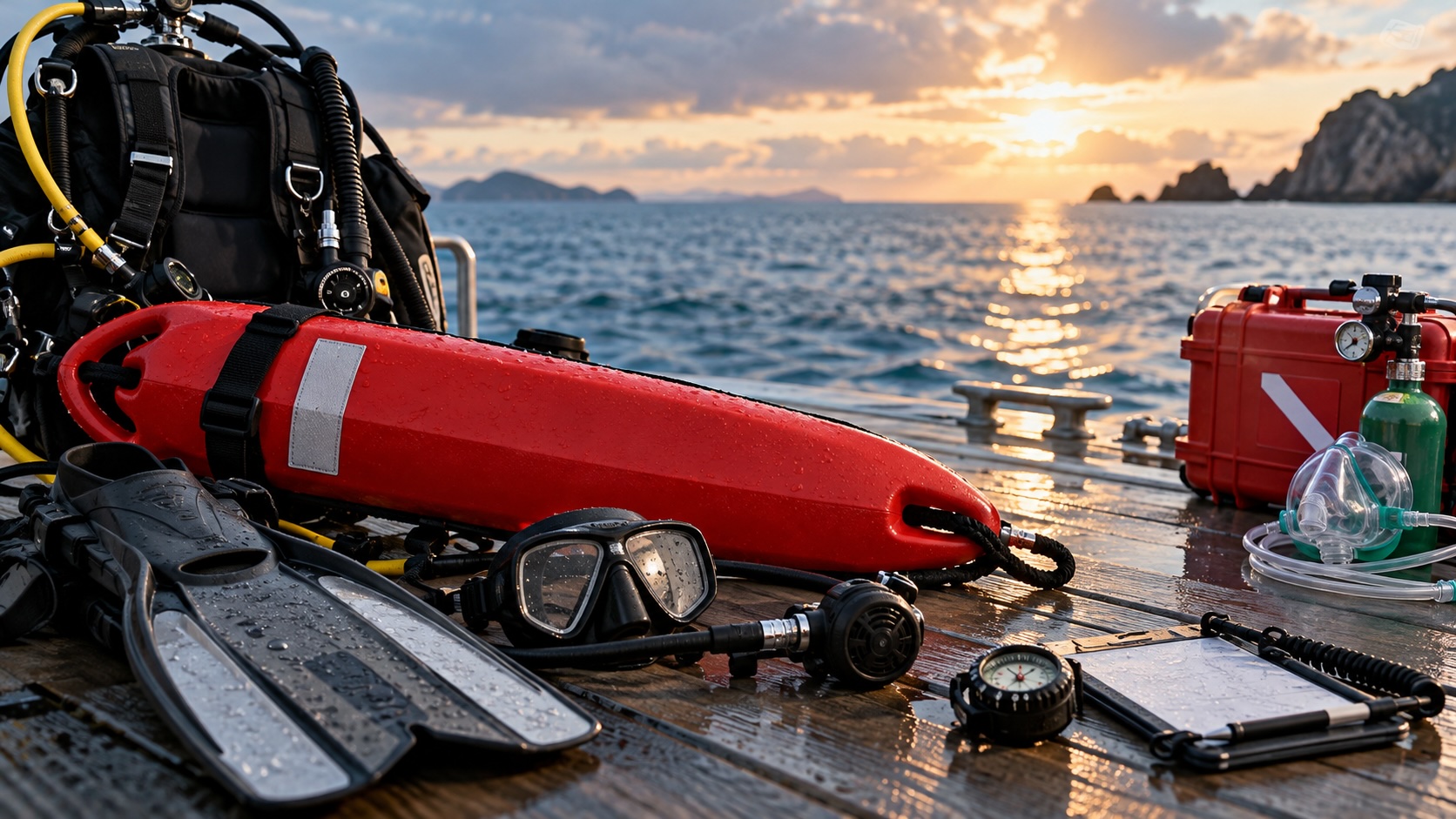
Rescue Diver isn’t about becoming a hero. It’s about learning to recognize problems, thinking through them before they happen, and becoming a better buddy.
I was cruising Reddit the other morning when I came across yet another discussion about the PADI Rescue Diver course. Someone was wondering whether they should take it, and people were offering all sorts of opinions about when to take it, how difficult it is, and where it fits into a diver’s progression.
I started typing out a response, but then I realized I have answered some version of this question in person dozens of times over the years. So instead of tossing another answer into the Reddit void, I figured I would answer it here for my own people, of which you are one, gentle reader.
The best place to start is with what I think of as the Big Three.
The Big Three
For a recreational diver, Open Water, Advanced Open Water, and Rescue Diver form a pretty natural progression. Not because everybody has to march through them on some fixed schedule, but because each course asks you to start thinking about diving a little differently.
Open Water: Learn to Take Care of Yourself
Open Water is the foundation. When you finish, you have demonstrated the minimum knowledge and skills necessary to go out and dive independently with another appropriately certified diver. Hopefully without hurting yourself.
That does not mean you are suddenly an experienced diver. It means you know how to assemble your equipment, descend, ascend, clear your mask, recover a regulator, establish buoyancy, monitor your air, share gas, and deal with basic problems.
When you are a brand-new diver, a whole lot of your brain is still occupied simply with the mechanics of being underwater. You are constantly thinking about your depth, your air supply, your buoyancy, your buddy, and what your computer is telling you. That is completely normal. There’s a lot going on down there, and getting comfortable with all of it takes practice.
Advanced Open Water: Discover the Art of the Possible
Advanced Open Water is really Open Water+. I have written before about why the name Advanced Open Water is a little misleading. You do not magically become an advanced diver after five more dives.
What AOW does is introduce you to the art of the possible. You get a taste of different kinds of diving and specialties, including deep diving and underwater navigation. Depending on the Adventure Dives you choose, you might also explore buoyancy, night diving, search and recovery, or any number of other possibilities. The point is exposure. You start discovering what else is out there and what kind of diver you might eventually want to become.
Then we get to Rescue.
Rescue Diver: Start Looking Outward
To me, Rescue Diver makes the most sense when taking care of yourself underwater no longer consumes all of your available brainpower. You do not need to be an expert, and you do not need some magical number of dives logged. You just need to be comfortable.
When your buoyancy is under control, your equipment feels familiar, and checking your gas supply has become second nature, you finally have enough mental bandwidth left over to pay attention to what is happening around you. That is where Rescue Diver really lands. It asks you to change your perspective. Instead of only asking, “Am I okay?” you start asking, “Is everybody else okay?”
Could You Take Rescue Almost Immediately?
Sure. There is no arbitrary number of dives at which somebody hands you a permission slip and says you are experienced enough to care about other people.
Under the PADI system, you can complete your four Open Water certification dives, move directly into the five Adventure Dives required for Advanced Open Water, and proceed almost immediately into Rescue training. In fact, PADI doesn’t even require the full Advanced Open Water certification; Adventure Diver with the Underwater Navigation Adventure Dive also satisfies the diving prerequisite.
If that is what you want to do, knock yourself out. I am not interested in gatekeeping anybody’s training. But being allowed to take a course and being at the point where you will maximize the value of that course are two different things.
I would rather ask a different question: How comfortable are you underwater?
If most of your attention is still devoted to managing your own dive, there is nothing wrong with getting some more dives under your belt first. Twenty dives might be plenty for one person, while fifty might not be enough for another. Someone who dives every weekend might become comfortable fairly quickly. Somebody who makes a handful of vacation dives every couple of years may need more time.
The number in your logbook is not the important part. Comfort is. And once you are comfortable managing yourself, you are in a much better position to start learning how to help manage somebody else’s problems.
Rescue Gives You a Framework
The biggest value of Rescue Diver, at least to me, is not any single skill. It gives you a cognitive framework for recognizing and dealing with problems. That might sound like a fancy way of saying you learn to pay attention, but there is a little more to it than that.
You start asking questions you may not have considered before:
- Is that diver just tired, or are they becoming distressed?
- Why did their breathing suddenly change?
- Why are they struggling to stay at the surface or suddenly vertical underwater?
- Why did somebody who was perfectly happy ten minutes ago suddenly get quiet?
- Can I help without putting myself in danger?
Rescue gives you tools for dealing with tired divers, panicked divers, distressed divers underwater, and missing divers. You learn how to bring an unresponsive diver to the surface, manage them at the surface, and get them out of the water. You also learn how to approach problems systematically rather than simply reacting to them.
A Little Underwater Black Magic
I took my own Rescue Diver course along the Southern California coast, and one of the things that surprised me most was learning underwater search patterns. Specifically, the expanding-square search.
If you have never tried one, the idea is pretty simple. You establish a starting point and swim an increasingly large square pattern around it, systematically covering more and more area. It sounds almost too simple to be particularly useful.
During my course, I was sent out to search for our simulated missing diver. I had essentially no idea where the guy was. But I followed the pattern. And damn it if I didn’t find him! It felt like black magic.
Of course, it wasn’t magic. It was a structured approach to a problem that I might otherwise have tried to solve by swimming around aimlessly and hoping to get lucky. That lesson stuck.
Another lesson came when I was tasked with bringing an unresponsive simulated victim to the surface and then getting him through the surf. The guy was north of 300 pounds. Now, I’m a pretty big guy myself, but holy cow was that difficult.
By the time I finished, I had developed a new appreciation for the physical demands of a rescue, especially when you’re dealing with someone much larger than yourself. Would I want to attempt something like that alone in a real emergency? Absolutely not. But knowing your own physical limitations, and when you need to call for backup, is just as important as knowing the techniques.
The Luxury of Making Mistakes
One thing I’ve noticed over the years teaching Rescue Diver is how quickly students can get themselves worked up during a scenario. They start rushing, get out of breath, and become so focused on accomplishing everything at once that they make the job considerably harder than it needs to be. In some cases, they start looking nearly as stressed as the person they’re supposed to be rescuing!
But this is training. As long as everybody is safe, we generally let the scenario play out. We finish the attempt, talk about what worked and what didn’t, and then try again. That’s the luxury of training: we get to make mistakes, learn from them, and try again without anybody getting hurt.
Frequently, the lesson is not that the student needs some entirely new rescue technique. They need to slow down. Think. Work through the problem methodically. There is a difference between acting with urgency and simply rushing around. That distinction becomes awfully important when something goes wrong for real.
Sometimes the Textbook Is Right on the Money
Back in 2017, I worked several Savage Race events as a rescue diver. I was part of a team assigned to monitor specific water obstacles and help participants who got into trouble. Our job was straightforward: make sure that everybody who jumped into the water came back to the surface.
There is a very real reason that job matters. In 2013, a participant named Avishek Sengupta drowned at a water obstacle during a Tough Mudder event in West Virginia. The organizers subsequently changed their procedures for monitoring participants entering and surfacing from the water. Tough Mudder and Savage Race are different organizations, but the underlying safety concern is the same: if somebody goes into the water, somebody needs to make sure they come back out.
At Savage Race, I spent most of the day in a wetsuit, wearing fins, and carrying a flotation device. Participants would jump from an elevated platform into the water, and we would watch them enter, surface, and make their way to the exit. And here’s something I noticed: the people who talked the most trash at the top of the obstacle were often the very people who couldn’t swim worth a damn!
Most made it through just fine. Others needed a little assistance. And some completely lost their minds once they hit the water.
One guy in particular gave me a real-world demonstration of something I had studied years earlier in my Rescue Diver course. He hit the water and absolutely panicked. I approached him and offered my flotation device, and he promptly climbed up onto it. So far, so good. Except he wasn’t finished climbing.
He proceeded to try to climb right up me. This guy was in full-blown panic mode, desperately trying to get himself out of the water, and apparently I looked like a pretty good ladder. I had fins, a wetsuit, and a flotation device keeping me at the surface; without that equipment, I’m convinced he would have pushed me underwater. It took three additional flotation devices brought in by other rescuers before he finally began to calm down.
When I originally went through Rescue Diver training, I remember reading about panicked divers and how they can grab onto rescuers, climb over them, and potentially endanger both people. It seemed a little counterintuitive at the time. Surely somebody who is being helped would recognize that pushing their rescuer underwater is a terrible idea?
Well, no. Somebody experiencing genuine panic isn’t calmly evaluating the situation. They are desperately trying to survive, and their behavior may be completely irrational. I’d read about it and practiced responses to it, but there it was in real life, right on top of me trying to shove me underwater. It was practically straight out of the Rescue Diver textbook.
At the end of one of those Savage Race days, my dive partner and I reflected on the fact that we’d participated in more water rescues that single day than we had in several years on our public safety dive team. Right place. Right time. Right job. And an excellent reminder that the things we learn during scuba training don’t always stay neatly confined to scuba diving.
Think About the Problem Before You Have the Problem
I’ve used this line before, and I believe it: “We practice emergencies because the first time we think about a problem should never be while it is unfolding in front of us.” I used that as the caption on the hero image for When the Drill Became Real, an article about a day when some of those training scenarios stopped being scenarios.
Emergencies do unpleasant things to the human brain. Stress narrows your attention, adrenaline shows up, and your perception of time changes. That is a lousy moment to invent a plan from scratch. Training gives your brain somewhere to start. It does not guarantee you will respond perfectly, but having encountered a problem in training means you have something to work from instead of starting from zero.
Building the Rest of the Toolkit
Rescue Diver doesn’t exist in a vacuum.
To earn the PADI Rescue Diver certification, you also need current CPR and First Aid training, completed within the previous 24 months. PADI’s Emergency First Response Primary and Secondary Care courses meet that requirement, as can qualifying training from other organizations, including appropriate courses from Divers Alert Network (DAN). If you don’t already have that training, it can be completed alongside your Rescue course.
And while Emergency Oxygen Provider training is not a separate prerequisite, I strongly recommend learning how to administer emergency oxygen. Because once you’ve recovered an injured or unresponsive diver, the problem isn’t necessarily over.
You may need to provide first aid, begin CPR, use an AED, administer emergency oxygen as appropriate, activate emergency medical services, or coordinate help while waiting for professional responders. Those are different skills, and each requires its own training and practice.
Rescue Diver doesn’t make you an emergency medical professional. Neither does a weekend CPR course. But putting these skills together gives you a much broader toolkit for dealing with an emergency, including what happens after someone is out of the water.
On a Long Enough Timeline, Something Goes Sideways
Most dives are wonderfully boring from a rescue standpoint. You jump in, look at cool stuff, annoy your buddy by pointing at the same turtle fourteen times, come back to the boat, and eat snacks. That’s exactly how I want it.
But on a long enough timeline, something eventually goes sideways, even if you do everything right. Equipment fails, conditions change, people get tired, seasick, or panic. Divers lose track of one another. A perfectly competent diver can simply have a very bad day. And sometimes another diver’s problem suddenly becomes your problem too.
That doesn’t mean scuba diving is inherently dangerous or that we should spend every dive waiting for something terrible to happen. Quite the opposite. Preparation gives you the freedom not to spend every dive worrying about catastrophe. You have thought about some of the problems. You have learned some tools. You have developed a framework. Then you go diving.
Rescue Diver Is Not Hero Training
There’s one part of how Rescue Diver sometimes gets discussed that bothers me: the chest thumping. Rescue Diver should not be a flex.
It does not make you a professional rescuer. It does not mean you should charge into situations beyond your training or put yourself in danger trying to help someone else. And I absolutely do not buy the idea that Rescue Diver is somehow “the most important course you will ever take.”
Come on. It’s an important course if you take it seriously. So are a lot of other courses. Rescue is another piece of the puzzle.
And while we’re at it, we should probably talk about another unrealistic expectation people sometimes have about rescue training. We’ve all seen the movies: somebody collapses, our hero starts pounding on their chest, dramatically yells “LIVE, DAMMIT!” and a few seconds later the victim suddenly sits up, takes a huge breath, and everybody celebrates.
Real life, and sometimes real death, doesn’t work that way. Resuscitation is hard. Outcomes are often poor, especially when a person has been without adequate oxygen for an extended period. Even with good CPR, an AED when appropriate, and prompt professional medical care, people do not always survive.
Sometimes you do everything right and the outcome is still terrible. We don’t get to promise otherwise. But we try anyway. Because helping someone who needs help, when we can do so safely and within our capabilities, is part of what people in a civilized society do for one another.
That’s not heroism. It’s humanity.
It Is a Way to Give Back
There is a point in your diving where you realize the experience is not just about you anymore. Your buddy matters, the new diver on the boat matters, the person who is nervous about making their first giant stride matters, the diver struggling to stay at the surface matters, and the group matters.
Rescue Diver gives you an opportunity to become a more useful member of that community. Maybe the most dramatic thing you ever do with your Rescue training is recognize that your buddy is exhausted and tow them twenty yards back to the boat. Good. Maybe you notice somebody getting stressed before panic ever develops and help solve the problem while it is still small. Even better. Because preventing an emergency is every bit as worthwhile as responding to one.
You don’t take Rescue Diver because you’re guaranteed to save somebody someday. You don’t take it because you need another certification card, or because you want to tell everybody how capable you are. You take it to learn something useful, to become more aware of the people around you, and maybe, someday, you’ll find yourself in a situation where something you learned during that course makes a difference.
Once you are comfortable taking care of yourself underwater, Rescue begins teaching you how to look beyond yourself. And that is a pretty worthwhile thing to learn.
Ready for the Next Step?
If you’re comfortable managing your own dive and ready to start looking out for the rest of the team, take a look at the PADI Rescue Diver course at Dive With Frank.
And if you’re still exploring your next step as a diver, visit the Why Diving? series for more articles about training, equipment, skills, and the experiences that make diving worthwhile.